



ITS Campus, ITS News — The threat of earthquakes always looms over Indonesia, a region located in the Pacific Ring of Fire, where tectonic plates meet. Based on this situation, the 251st Professor of the Sepuluh Nopember Institute of Technology (ITS), Prof. Data Iranata, ST, MT, PhD, developed a model for composite steel-concrete beam-column connections to improve the earthquake resistance of buildings.
The Professor from the Civil Engineering Department of the Faculty of Civil, Planning, and Geotechnical Engineering (FTSPK) at ITS explained that the primary cause of loss of life during an earthquake is not the earthquake itself. He believes that loss of life occurs because buildings fail to withstand the forces of earthquakes due to improper structural design. “If buildings are designed in accordance with applicable regulations, the extent of earthquake damage can actually be predicted and controlled,” Data said.
The man born on April 30, 1980, explained that the main goal of structural engineering is not to create buildings that are completely undamaged during an earthquake. Instead, buildings must be designed to withstand damage at predetermined points, so that columns remain standing and the building does not collapse. “Occupants must have the opportunity to evacuate safely before the building collapses or is damaged to minimize loss of life,” he added.
As a solution, the ITS Civil Engineering graduate developed a Steel Reinforced Concrete (SRC) beam-column connection model using Finite Element Method (FEM) modeling . “Steel has better ductility than concrete in absorbing earthquake energy,” he explained.
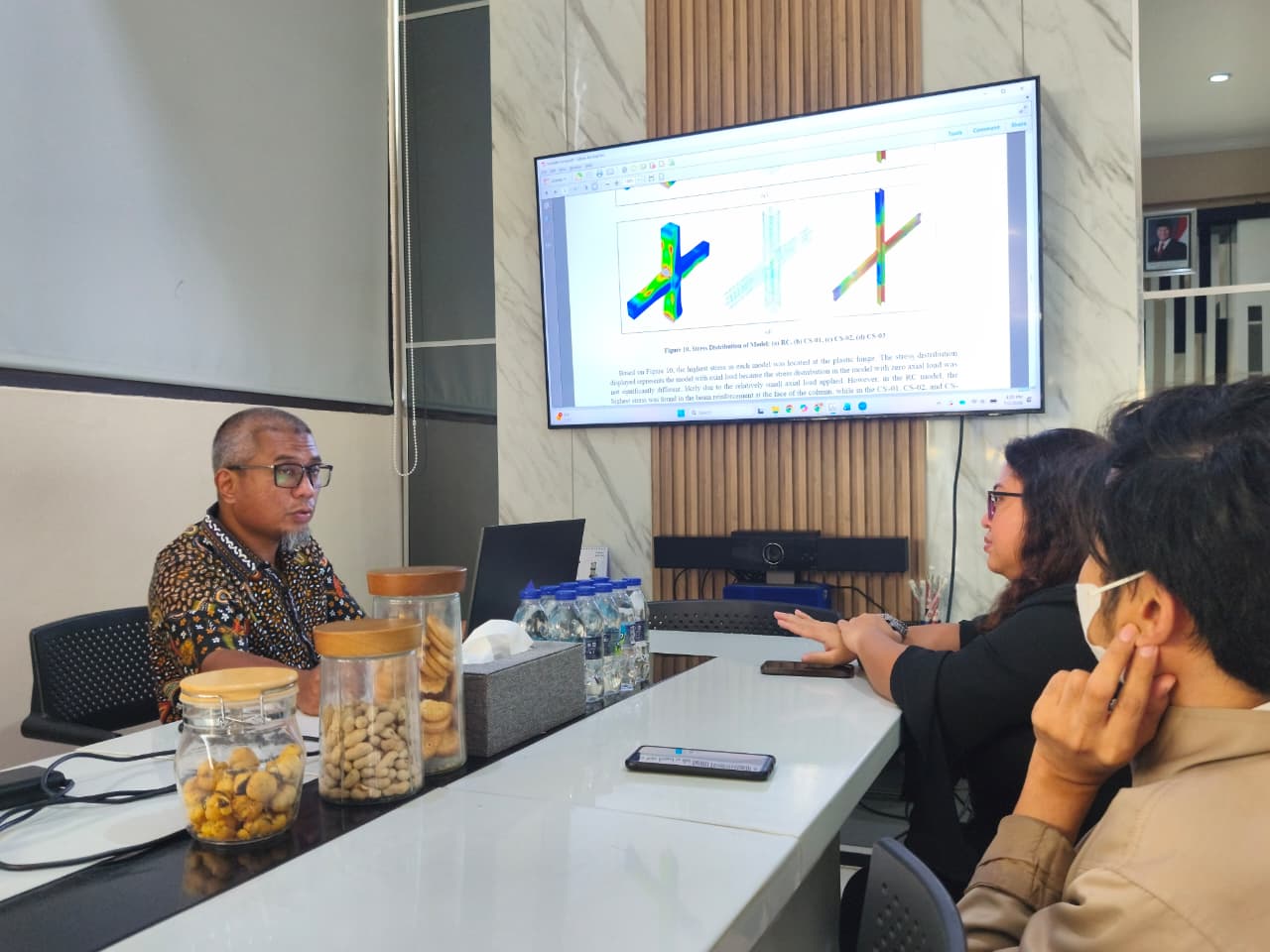
However, Data continued, adding steel profiles does not guarantee increased structural durability. Therefore, this study developed several steel profile embedment configurations and analyzed their structural interactions.
In more detail, Data developed several connection configurations, namely CS-01, CS-02, and CS-03, through numerical simulation-based structural modeling. In CS-01, the composite configuration consists of Wide Flange (WF) steel embedded in reinforced concrete and bound by stirrups.
Meanwhile, for code CS-02, the WF steel connections are not tied with stirrups. Finally, code CS-03 is the most distinctive configuration because the connected beams are solid steel.
The data shows that the research results prove that adding as much steel as possible to a structure does not always result in better structural performance. A properly designed connection configuration has been shown to be more decisive in the structure’s ability to distribute stress, absorb earthquake energy, and control damage patterns. “Of all the configurations analyzed, the CS-02 model demonstrated the most optimal seismic performance,” he explained.
Through the development of this connection model, Data hopes that the implementation of earthquake-resistant building designs in Indonesia will increasingly prioritize safety aspects without compromising construction efficiency. This effort is expected to support the realization of safer, more resilient, and more sustainable infrastructure in line with Sustainable Development Goal (SDG) 9 on Industry, Innovation, and Infrastructure. (ITS Public Relations)
Reporter: Aulia Okta Wijaya