
Published on
Friday, 24 April 2026

ITS Campus, ITS News — The difficulty of facing critical challenges in textile industry monitoring causes negative impacts on production costs. Responding to these issues, a graduate of the doctoral program at the Department of Systems and Industrial Engineering (DTSI) Institut Teknologi Sepuluh Nopember (ITS), Dr Fajar Pitarsi Dharma SST MT, developed a textile quality control system through the integration of machine learning.
Through the DTSI 133 Doctoral Promotion Open Session, Fajar revealed that the Indonesian textile industry is considered inconsistent in conducting quality supervision. Furthermore, manual inspections produce low accuracy, ranging only from 50 to 70 percent. “This results in delays in detecting defects while simultaneously lowering the production rate,” he added.
The alumnus of the Universitas Mercu Buana Master’s program proposed a framework in the form of a dual strategy that integrates a convolutional neural network to classify types of defects and an object detection model. This model is used to spatially localize defects in weaving products, specifically in fabrics. The system allows for a faster and more precise defect identification process, thereby supporting real-time quality supervision.
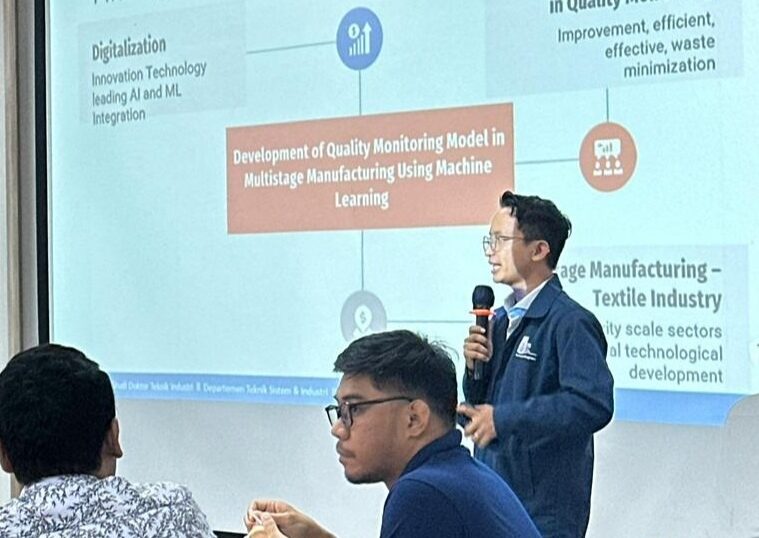
Furthermore, this research utilizes four main stages to improve model performance. These stages include a thorough literature analysis and a comparison of various detection architectures on public data. Additionally, the system develops a classification model with a hierarchical attention mechanism from the initial to the final stages of production, as well as performing hyperparameter optimization to enhance detection capabilities.
Through this methodology, the research results show a high level of significance. The developed classification model achieved an accuracy of up to 94 percent in identifying types of defects. The optimized detection model also achieved a 17 percent increase in mean average precision with superior performance compared to available state-of-the-art methods. “This result surpasses the baseline by up to 22 percentage points,” he revealed.
Moreover, this framework has been statistically validated through various randomized tests showing a high level of consistency and stability in quality control. Additionally, the applied optimization strategy prioritizes model configuration before architectural capacity development and considers technical aspects and industrial operational needs. This provides practical guidance for the digital transformation of quality control in the Indonesian textile industry.
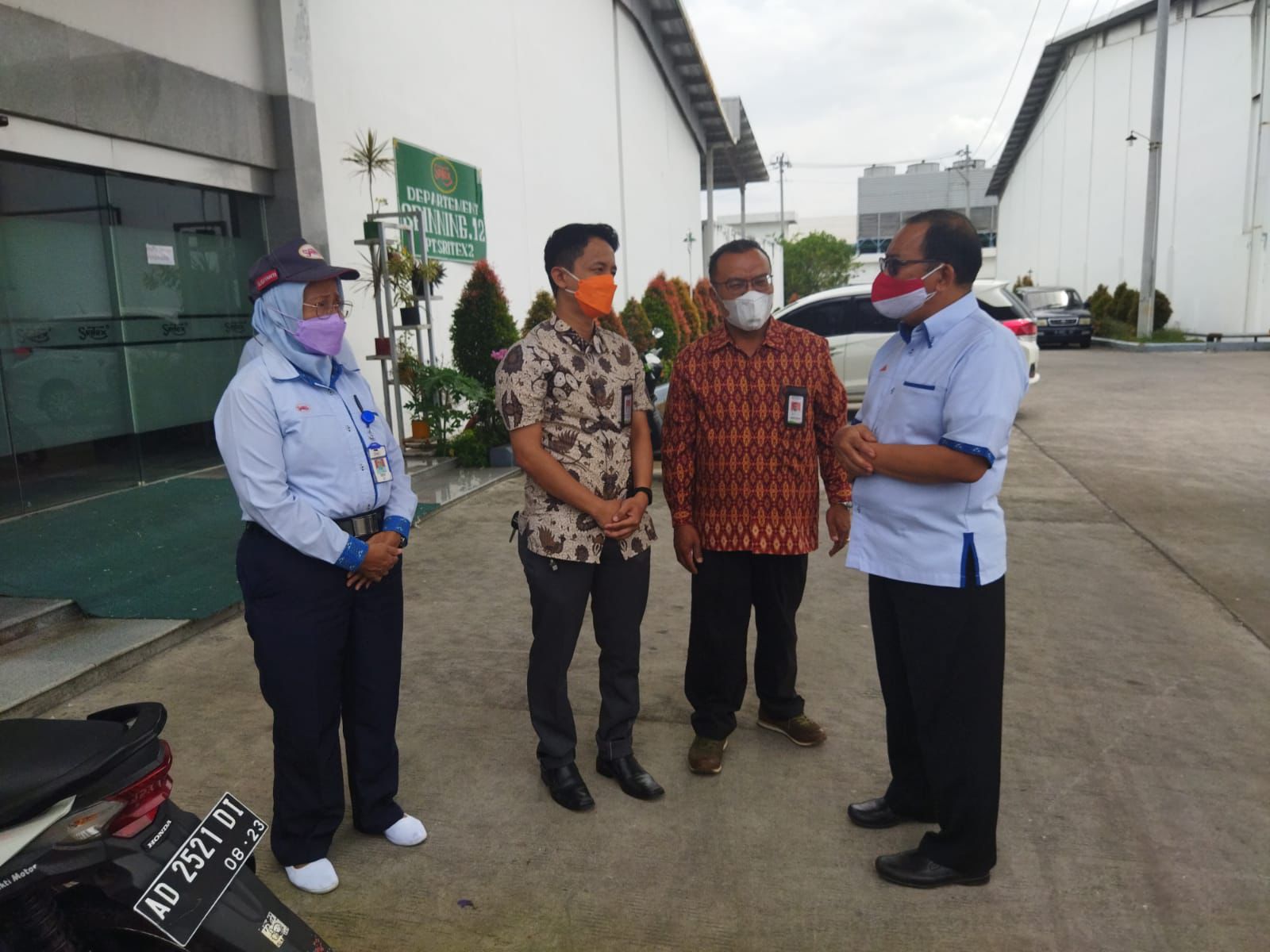
The hope is that this research can be adopted in real textile industry environments. Intense testing of this framework can form a pilot scale in one production line, eventually becoming a fully integrated automated inspection system. Furthermore, the development of lighter models can run on more affordable edge computing devices, allowing medium-scale textile factories to adopt them without large infrastructure investments.
This innovation also aligns with the support for achieving the Sustainable Development Goals (SDGs). Specifically, point 8 regarding Decent Work and Economic Growth; point 9 regarding Industry, Innovation, and Infrastructure; and point 12 regarding Responsible Consumption and Production. “The presence of this innovation is expected to foster technological inclusivity, the sustainability of textile industry efficiency, and a more responsible production process,” he said hopefully. (ITS PUBLIC RELATIONS)
Reporter: Mohammad Fariz Irwansyah