
Published on
Thursday, 16 April 2026
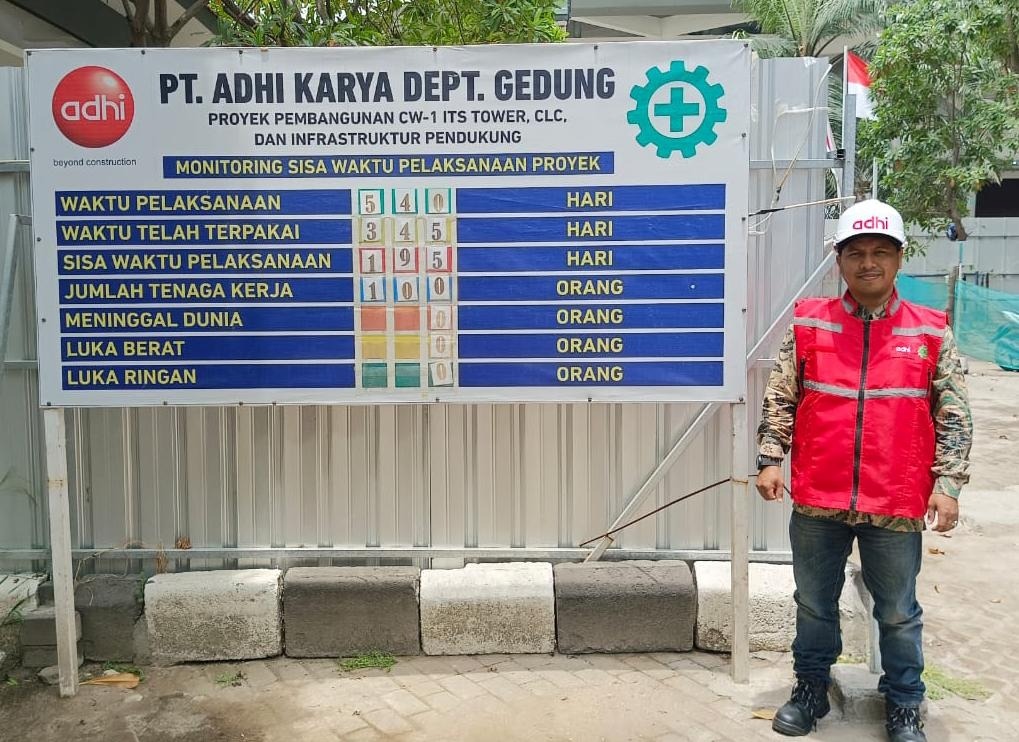
ITS Campus, News — The pace of high-rise building construction in Indonesia is still overshadowed by high occupational accidents due to the suboptimal implementation of Occupational Health and Safety (K3). Responding to these conditions, a doctoral program graduate of the Systems and Industrial Engineering Department of Institut Teknologi Sepuluh Nopember (ITS) Dr Ryan Pramanda Isni ST MT developed an ergo-safety model for high-rise building projects.
Ryan revealed that the current occupational safety system still tends to focus on general management aspects. As a result, important factors such as the physical and mental condition of workers are often neglected in field K3 practices. “So far, the safety approach has been seen more from the system side, even though human factors are also highly decisive,” he reminded.
Furthermore, Ryan stated that there is a need for a model capable of properly integrating human aspects and work systems. To realize this, this lecturer from Samudra University, Aceh used the Human Interface System (HIS) and Human Factor Analysis Classification System (HFACS) paradigms. “This aims to identify the pattern of accident causes through the interaction between humans and the work system,” he explained.

From these two paradigms, Ryan involved 28 construction experts to conduct an in-depth assessment of the conditions of 277 workers in the field. The results of this assessment then became the main dataset of his ergo-safety model. “This data can provide a strong probability foundation so that this risk simulation model becomes more accurate,” he explained.
Furthermore, the data was processed using the Bayesian Belief Network (BBN) method with RStudio. The man from Langsa, Aceh explained that through BBN, the relationship between data factors can be mapped systematically. Thus, factors such as worker conditions, the work environment, up to the organizational system are analyzed to see their interconnections.
From the application of the ergo-safety model, Ryan found that the physical and mental condition of workers becomes the most influential factor on the level of occupational safety. Fatigue and psychological pressure are proven to increase the risk of accidents, especially in construction work. “From the results of this analysis, companies can plan a more well-planned and effective K3,” he asserted.
In addition, Ryan also highlighted that safety procedures that are too complex can actually hinder effective K3 implementation. According to him, an effective system must be easily understood and applied by construction workers. “Sophisticated equipment will not be effective if it is not supported by ease of use,” he added.
This research also supports the achievement of the Sustainable Development Goals (SDGs) commitment on point 3, namely Good Health and Well-being. Ryan hopes the ergonomics model he developed can become an input in improving occupational safety standards in the construction sector. “The hope is that this model can support the achievement of the zero accident target sustainably,” he asserted optimistically. (ITS Public Relations)
Reporter: Khaila Bening Amanda Putri