Learning Sustainability from the Land of a Thousand Lakes: My Erasmus+ Student Exchange Experience at Haaga-Helia University of Applied Sciences, Finland
Learning Sustainability from the Land of a Thousand Lakes: My Erasmus+ Student Exchange Experience at Haaga-Helia University of Applied Sciences, Finland
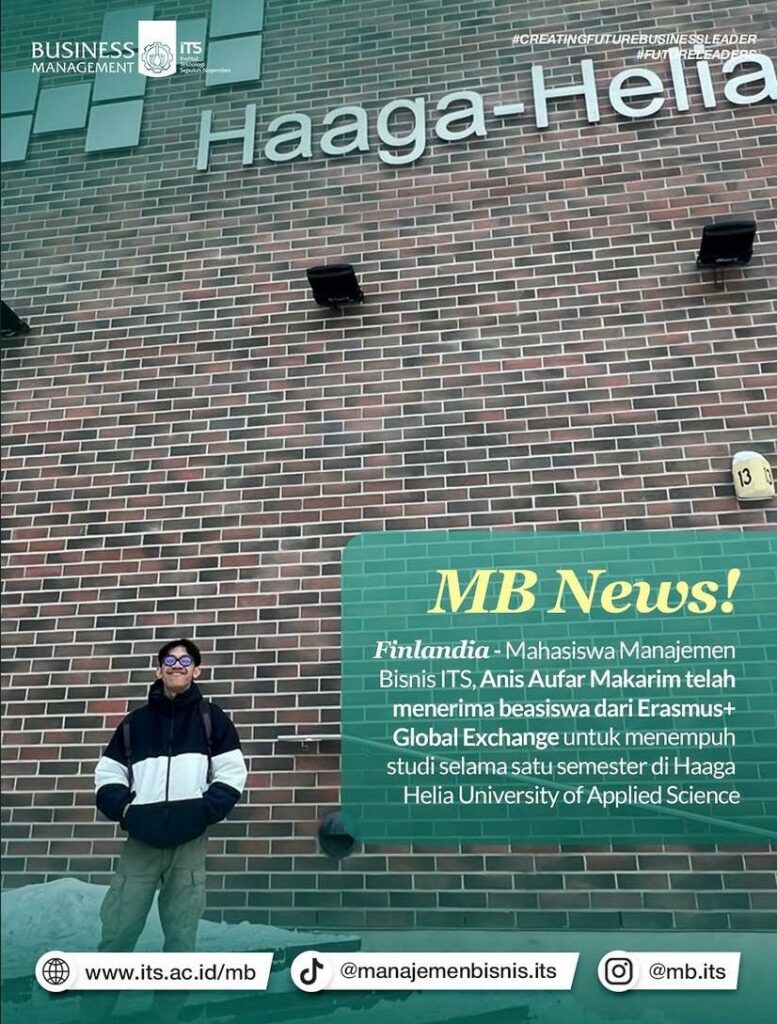
Studying abroad had been one of my biggest aspirations ever since I began my journey as a student at the Department of Business Management, Institut Teknologi Sepuluh Nopember (ITS). To me, participating in a student exchange program was not merely an opportunity to study in another country, but also a chance to observe firsthand how a developed nation builds its education system, industries, and society. My interest in sustainability, combined with Finland’s reputation as one of the world’s leading countries in education, inspired me to join the Erasmus+ Student Exchange Program at Haaga-Helia University of Applied Sciences, Finland, where I spent five months from January to May.
Before leaving Indonesia, I was filled with both excitement and uncertainty. I was eager to discover how sustainability principles were genuinely implemented in everyday life, particularly in the hospitality and tourism sectors, which were the primary focus of my studies. At the same time, I wondered whether I would be able to adapt to a new language, culture, and environment without knowing anyone there. Fortunately, those concerns gradually disappeared as I met students from all over the world who were incredibly welcoming and enthusiastic about learning from one another.
One of the most memorable experiences happened during my very first days in Finland. I arrived in the middle of winter when the sun did not rise until around 9:30 a.m., while my classes started at 8:00 a.m. It felt both fascinating and surreal to leave for campus while it was still completely dark outside, almost as if the day had not yet begun. This simple experience reminded me that living in another country also means adapting to an entirely different rhythm of daily life.
As a university of applied sciences, Haaga-Helia adopts a highly practice-oriented approach to education. Many of the lecturers are active professionals in their respective industries, making every classroom discussion rich with real-world case studies and professional insights. Learning extended far beyond theoretical concepts, as students were constantly challenged to solve practical problems that reflected current industry needs.
One of the most rewarding projects involved designing a sustainable travel package for the Norwegian Fjords. Through this project, I learned that sustainability in tourism goes far beyond environmental conservation. It also requires balancing economic growth, social well-being, and cultural preservation. Another valuable learning experience took place at Suomenlinna, a UNESCO World Heritage Site in Finland. Observing how this historic site is managed provided a clear example of how governments, local communities, and industry stakeholders collaborate to preserve cultural heritage while ensuring its long-term sustainability.
Outside the classroom, life in Finland was equally enriching. I lived in student housing alongside fellow international students, making every day an opportunity to experience different cultures. One of my favorite local dishes was salmon soup, a simple yet comforting meal that was perfect during the cold winter months. I was also deeply impressed by Finland’s public transportation system. Every mode of transportation was seamlessly integrated, making travel efficient, convenient, and remarkably punctual.
Another aspect that caught my attention was the Finnish people’s deep respect for personal space. For example, while waiting in line for a bus, everyone naturally maintained a comfortable distance from one another without any reminders. At first, this felt quite different from life in Indonesia, where people tend to be more warm, expressive, and socially interactive. However, over time, I came to appreciate that every culture has its own unique way of showing respect and consideration for others.
The Erasmus+ program also provided me with invaluable opportunities to build an international network. I met students from many countries, particularly across the European Union, each bringing different perspectives and experiences to every discussion. Exchanging stories about our cultures, education systems, and the challenges faced in our respective countries broadened my understanding of the importance of collaboration in multicultural environments.
Among all the unforgettable experiences, two moments stand out the most. The first was attending a Thai cultural festival organized by the international student community. The event beautifully demonstrated how cultural diversity creates opportunities for people to learn from and appreciate one another. The second unforgettable moment happened unexpectedly when I witnessed the Northern Lights dancing across the sky near my residence. As one of the northernmost countries in the world, Finland offers the rare opportunity to experience this breathtaking natural phenomenon firsthand. It was truly a once-in-a-lifetime experience that I will always cherish.
The greatest challenge throughout the exchange program was adapting to Finland’s harsh winter climate. Coming from Surabaya, where temperatures typically exceed 30°C, adjusting to winter temperatures that dropped to around −25°C required significant physical and mental adaptation. Even simple daily activities, such as walking to campus, demanded much more preparation than they would in Indonesia. Nevertheless, this experience taught me the importance of resilience, adaptability, and maintaining productivity even in completely unfamiliar circumstances.
Throughout my exchange journey, I also realized how well my academic experience at the Department of Business Management, ITS, had prepared me for studying abroad. The department’s international environment, with many incoming exchange students from various countries, had already given me valuable opportunities to interact with people from diverse cultural backgrounds. These experiences strengthened my confidence and enabled me to collaborate effectively with classmates from around the world.
Returning to Indonesia, I brought home far more than academic knowledge. I gained a deeper understanding of how sustainability principles are implemented in the hospitality and tourism sectors—from destination planning to cultural heritage management. I was also inspired by the Nordic innovation ecosystem, where I had the opportunity to meet entrepreneurs, startup founders, and industry professionals who demonstrated how innovation flourishes through collaboration, experimentation, and a supportive ecosystem.