Surabaya, IT Journalistic — The Department of Information Technology (DTI) at Institut Teknologi Sepuluh Nopember (ITS) has developed an emergency alert system based on the Internet of Things (IoT), called Panic Button, to improve residential neighborhood safety. Through a community service program, the DTI ITS team held a socialization session and training on how to use the system at the RW 09 Community Hall in Bendul Merisi, Wonocolo District, Surabaya, on Saturday (November 7).
The activity was led by Hafara Firdausi, S.Kom., M.Kom., as the head of the community service team, alongside other DTI ITS lecturers, namely Ridho Rahman Hariadi, S.Kom., M.Sc., Fuad Dary Rosyadi, S.Kom., M.Kom., and Dr. Ir. Henning Titi Ciptaningtyas, S.Kom., M.Kom. The Panic Button system was designed and developed by Ridho Rahman Hariadi and Fuad Dary Rosyadi. The team also involved DTI ITS students participating in the Community Service Program (KKN), namely Fika Arka Nuriyah, Zahra Hafizhah, M. Hikari Reiziq Rakhmadinta, Oryza Qiara Ramadhani, Diva Aulia Rosa, Az Zahrra Tasya Adelia, and Naila Cahyarani Idelia.
The socialization session was attended by the Chair of RW 09, several heads of neighborhood units (RT) within RW 09, members of the RT 05 security team, and local residents. Prior to the event, the DTI ITS team had held discussions with Yossi Al Amien, Head of RT 05, who subsequently agreed to have the system installed in his neighborhood. The activity provided residents with an opportunity to learn about the system and try it out firsthand.
The program was initiated in response to residents’ need for an emergency communication tool that could accelerate coordination among community members. So far, emergency information has often been communicated individually, for example, by directly contacting the head of the neighborhood unit or security personnel. This approach could potentially delay emergency responses if the relevant parties cannot be reached immediately.
Hafara Firdausi, S.Kom., M.Kom. (left), Ridho Rahman Hariadi, S.Kom., M.Sc. (center), and Fuad Dary Rosyadi, S.Kom., M.Kom. (right) pose with residents of Bendul Merisi during a socialization session and training on the use of the IoT-based Panic Button system.
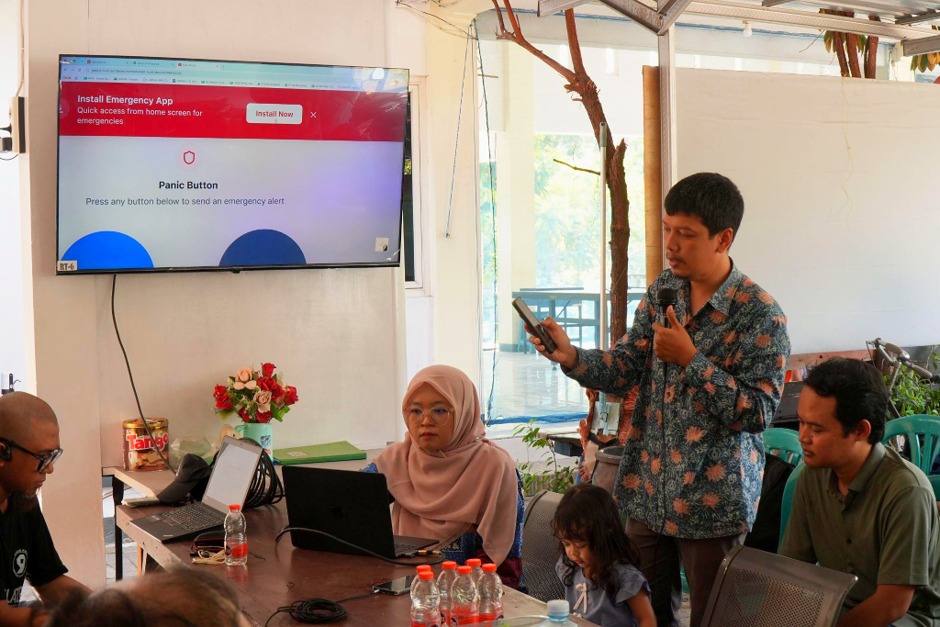
The Panic Button system consists of three main components: an administrative dashboard, a Panic Button application for residents, and a Panic Speaker for neighborhood administrators. The web-based application can be accessed by residents through their smartphones, with individual access granted using their registered WhatsApp numbers. Through the application, residents can select from several available emergency categories, such as accidents, theft, fires, and the presence of wild animals.
Meanwhile, the administrative dashboard is used to manage residents’ data, configure alarm settings, and determine emergency categories. The Panic Speaker, on the other hand, is a device used by RT administrators to receive emergency alerts. When a resident presses one of the emergency buttons, the information is forwarded to the device. Using Text-to-Speech (TTS) technology, the device can audibly announce the location of the resident in need of assistance, including their block and house number. This mechanism allows neighborhood administrators to identify the location of an incident without having to search for the information manually.
In its implementation, the system also allows emergency alerts to be delivered in stages. Notifications received by RT administrators can first be assessed based on the urgency of the situation. If an incident requires a broader response, the information can then be broadcast through public loudspeakers to reach other residents. This ensures that not every report needs to be announced immediately through loudspeakers, which could otherwise disrupt community activities.
During the event, the DTI ITS team also held discussions with residents to explore their needs and identify opportunities for implementing the system in the neighborhood. One suggestion was to install loudspeakers on tall poles or near the local mosque so that emergency alerts could reach more residents. On the other hand, residents also expressed concerns about the potential misuse of the emergency button for minor incidents, such as a cat entering someone’s house, which could unnecessarily cause panic throughout the neighborhood.
Residents also raised questions about the appropriate use of loudspeakers at night. The neighborhood observes quiet hours starting at around 9 p.m., prompting concerns about whether alerts should still be broadcast if an emergency occurs after that time. So far, residents have been accustomed to contacting their RT head directly when they need assistance at night. This consideration plays an important role in determining an alert mechanism that takes both the urgency of an incident and residents’ comfort into account.
In response to these suggestions, the team and residents discussed an alternative mechanism for delivering alerts in stages. When a resident presses the emergency button, the notification is first received by the RT administrators through the Panic Speaker. If the administrators determine that the incident requires a broader response, the information can then be relayed through public loudspeakers. Conversely, minor incidents can be handled directly by the RT head or neighborhood administrators without broadcasting an alert to the entire community.
“I’m pleased to see the residents’ enthusiasm for technology. At the same time, they continue to uphold the ethics and norms of the community, which made the discussion engaging,” said Hafara.
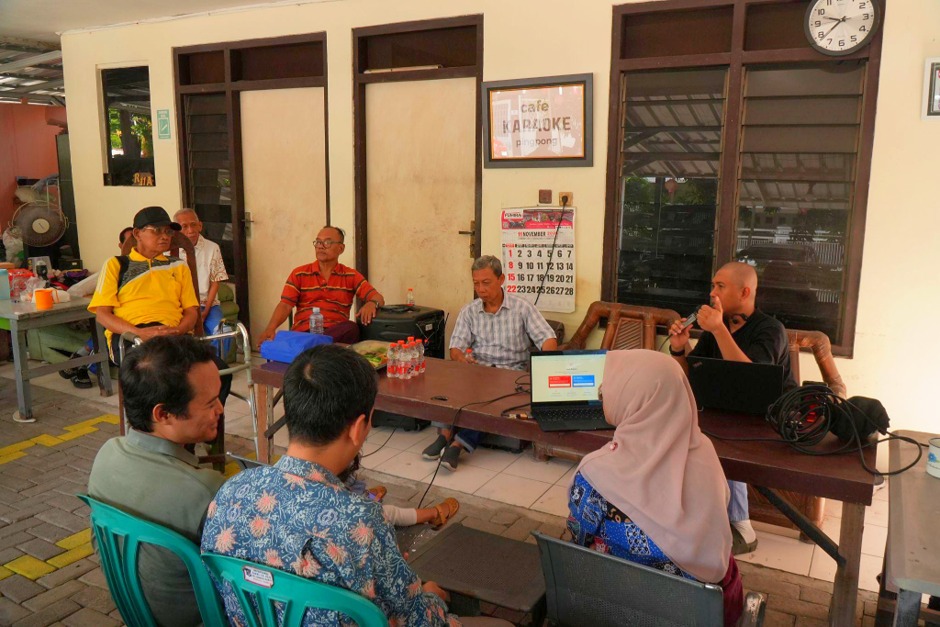
The DTI ITS team assists residents of Bendul Merisi and demonstrates how to use the Panic Button application.
Positive feedback was shared by Wirawan Swastomoradjo, Head of RT 02, RW 09, Bendul Merisi Permai. He believes that the Panic Button system can accelerate coordination between neighborhood administrators and security personnel. According to him, using a mobile application is well suited to the needs of his neighborhood, as it enables a rapid response without causing disturbances among residents.
“The system is already very good, simple, easy to use, and enables a fast response. I think this application is very beneficial,” said Wirawan, sharing his impressions after trying the system.
A similar view was expressed by Jusli, a representative of the RT 05 security committee. He believes that the system could help residents, particularly since a large proportion of the people in his neighborhood are elderly. He recounted an incident involving an elderly resident who lived alone and had fallen in the bathroom but was unable to call for help for several hours. This incident highlights the importance of an emergency communication tool that enables residents to receive assistance in urgent situations.
Based on his trial of the application, Jusli found the Panic Button easy to use. Nevertheless, he offered several suggestions to improve its accessibility, including increasing the font size to make it easier for elderly residents to read. “It’s quite easy to use, but perhaps the font could be made bigger,” he suggested.
In addition, he proposed optimizing the GPS feature so that the location of residents who press the emergency button would appear directly on the notification recipient’s screen, alongside the voice announcement. This would allow neighborhood administrators and security personnel to identify the incident location without having to open a separate map. The suggestion will serve as one of the evaluation points for improving the system’s usability for people of all age groups.
Other residents also shared several development ideas, including integrating notifications with residents’ WhatsApp groups so that emergency information could be delivered through a familiar communication channel. Another suggestion was to introduce a feature for tracking perpetrators in the event of theft, although this would require further technical assessment before it could be implemented.
Device connectivity was also a topic of discussion. Residents suggested that the system should not rely solely on a LAN connection but should also support other networks, such as Wi-Fi, to accommodate the infrastructure conditions of different neighborhoods. This feedback aligns with the Panic Button development principle of prioritizing flexibility and adapting to community needs.
Beyond functionality and ease of use, the discussion also addressed personal data security. Jusli raised concerns about the protection of residents’ personal information, such as registered phone numbers, given that the system is currently hosted on DTI ITS servers. This concern is important, as residents’ personal data must be properly managed to prevent misuse.
In response, the DTI ITS team explained that it is responsible for safeguarding the data stored on its servers. However, if the RW or RT administrators wish to manage the system independently, the team also allows it to be installed on a server owned by the residents. This provides flexibility in managing the system according to the needs and policies of each neighborhood.
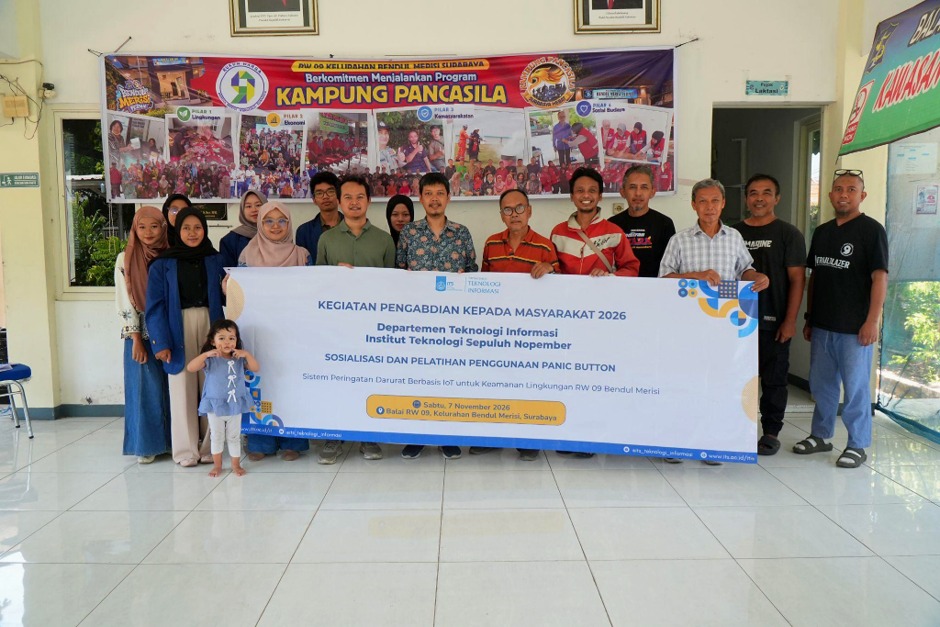
The DTI ITS team and residents of Bendul Merisi pose for a group photo following the socialization session and training on the use of the IoT-based Panic Button system.
Moving forward, the DTI ITS team is committed to continuously developing the Panic Button system based on evaluations and feedback from residents. Feature adjustments, improved user-friendliness, enhanced connectivity, and refinements to the alert delivery mechanism are among the aspects that can be further developed. Through collaboration between higher education institutions and the community, this innovation is expected to serve as an effective technology-based solution that contributes to creating safer residential neighborhoods that are better prepared to respond to emergencies.
Contributions to the Sustainable Development Goals (SDGs)
This community service program contributes to the Sustainable Development Goals (SDGs), particularly:
- SDG 9: Industry, Innovation and Infrastructure, through the development of an IoT-based emergency alert system as a technological innovation that supports neighborhood security infrastructure.
- SDG 11: Sustainable Cities and Communities, through the provision of an emergency communication tool that improves preparedness and safety in residential areas.
- SDG 16: Peace, Justice and Strong Institutions, through strengthened coordination among residents, neighborhood administrators, and security personnel in responding to emergency situations.
Through the development of the Panic Button system, DTI ITS seeks to promote the use of technology that is not only innovative but also adaptable to community needs. Residents’ involvement in the evaluation and development process is expected to support the system’s long-term sustainability while improving neighborhood safety.
Reporter: Nafis Faqih
=================================================================
Information provided by:
Department of Technology Information
Website: its.ac.id/it
Instagram: its_teknologi_informasi
Youtube: Teknologi Informasi ITS