Surabaya, IT Journalistic – The Department of Information Technology (DTI) at Institut Teknologi Sepuluh Nopember (ITS) held a Summer Research Internship Coaching Session featuring Ganesh Neelakanta Iyer, Ph.D., Senior Lecturer at the Department of Computer Science, School of Computing, National University of Singapore (NUS). The event took place on Monday, November 23, 2026, from 9:00 to 11:00 AM (Western Indonesia Time) at the 11th-Floor Hall. The session aimed to broaden DTI ITS students’ perspectives on opportunities to participate in the Summer Research Internship (SRI) program and pursue further studies at the Master’s and Ph.D. levels at NUS.
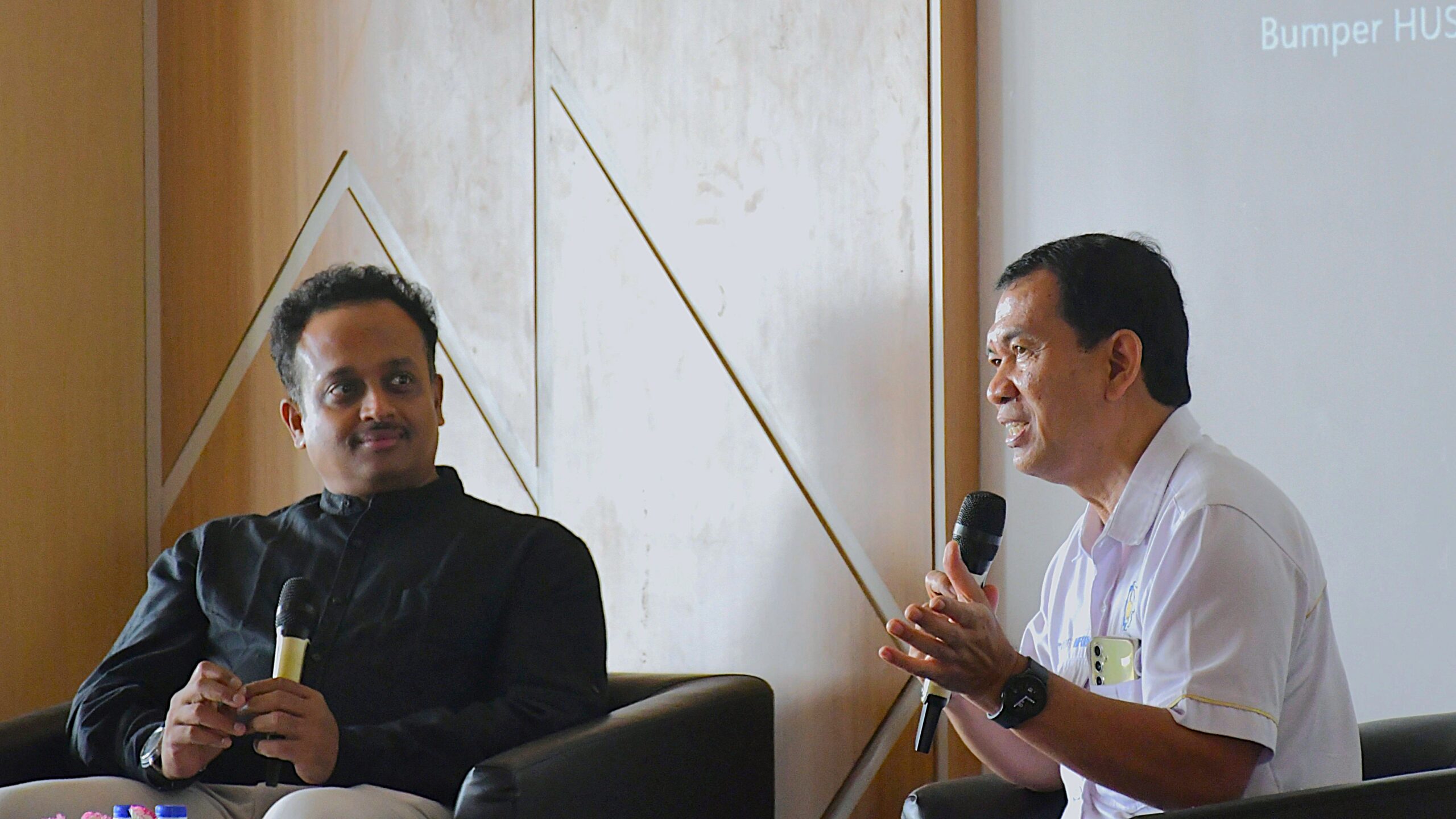
From left: Ganesh Neelakanta Iyer, Ph.D., and Head of the ITS Department of Information Technology, Dr.techn. Ir. Raden Venantius Hari Ginardi, M.Sc., at the opening of the Summer Research Internship Coaching Session.
The session was organized in response to the growing interest among students in research opportunities and pursuing higher education abroad. Currently, approximately 60–70 percent of Ph.D. students at NUS come from China and India, as their application profiles are highly competitive. To increase the diversity of its research student population, NUS has introduced the SRI program specifically for students from ASEAN countries, including Indonesia, Malaysia, Thailand, and Vietnam. This dedicated program is not open to Chinese or Indian nationals.
The program is primarily aimed at undergraduate students, while also welcoming Master’s students and early-career lecturers who have not yet pursued a Ph.D. Its main objective is to develop research skills rather than simply provide an industrial internship experience. The event began with a presentation by Ganesh Neelakanta Iyer, Ph.D., and concluded with an interactive question-and-answer session involving DTI ITS students in attendance.
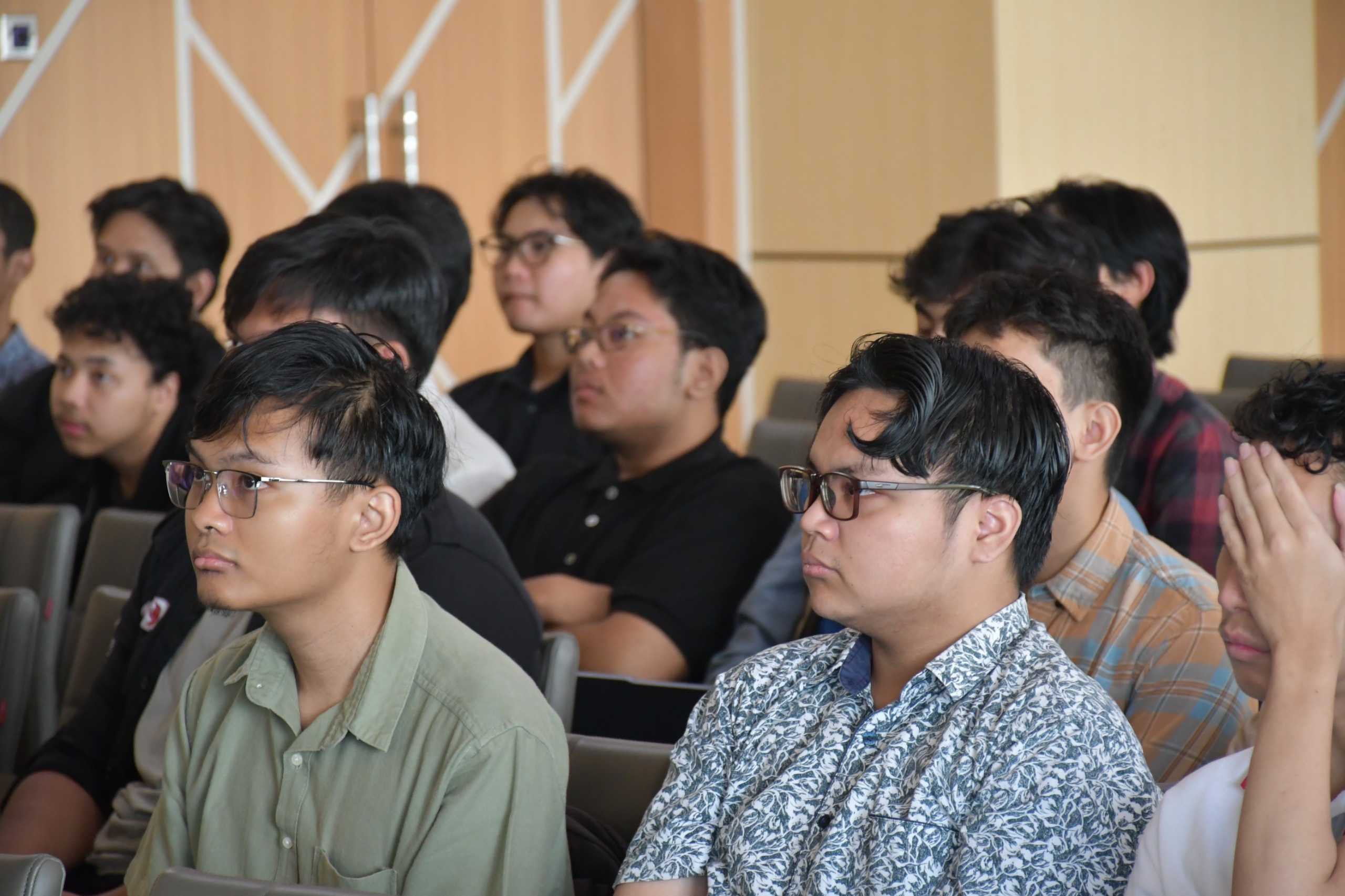
DTI ITS students listen attentively to the presentation delivered by Ganesh Neelakanta Iyer, Ph.D., at the 11th-Floor Hall.
In his presentation, Ganesh Neelakanta Iyer, Ph.D., introduced the NUS School of Computing, which was established in 1975. The school ranks fourth globally in Computer Science and Information Systems and third globally in Data Science and Artificial Intelligence. It also ranks first in Asia and eighth worldwide in graduate employability. In the research field, the school currently manages approximately 370 active projects, focusing on artificial intelligence, hardware security, and software engineering. For undergraduate students, NUS offers enrichment programs such as the Undergraduate Research Opportunities Programme (UROP) and NUS Overseas Colleges (NOC). The NOC program provides startup incubation opportunities lasting between six and twelve months.
Following the introduction to the NUS School of Computing, Ganesh Neelakanta Iyer, Ph.D., elaborated on the SRI program, which was the main focus of the session. Selected students receive a scholarship of SGD 5,000 for a ten-week internship. This amount is intended to cover airfare, accommodation, and meals in Singapore, and is disbursed monthly after students arrive. In addition to the scholarship, successful applicants receive a temporary work visa in the form of a Training Employment Pass, weekly guidance from academic supervisors, and opportunities to attend seminars and build networks with NUS students and faculty members. Internship schedules can be adjusted to accommodate each university’s academic calendar, with placements available between May and September. Applications for the SRI program close on January 15, with approximately 30–40 students selected from 700–800 applicants.
Beyond the SRI program, Ganesh Neelakanta Iyer, Ph.D., also explained the postgraduate study pathways available at NUS. The Master of Computing program offers specializations in Computer Science, Information Systems, and Infocomm Security, with a duration of 1.5–2 years for full-time students and a total workload of 40 credits. Applications open once a year for the August intake, with the application period running from October to February. NUS also offers a Master of Computing in Artificial Intelligence, a General Track for graduates from non-computing backgrounds, and an M.Sc. in Digital Financial Technology.
For Ph.D. programs, admissions take place twice a year, in August and January. Admitted students receive a fully funded four-year scholarship without a service bond and without depending on their supervisors’ research grants. Ph.D. students receive a monthly stipend of SGD 2,700, which increases to SGD 3,500 after passing the Qualifying Examination. Applicants are not required to identify a supervisor before applying, as NUS provides a one-semester Research Training program involving rotations in two laboratories. During this program, professors first introduce their respective research areas. Students then select two professors from among the presenters and undertake a one-semester research placement in each professor’s laboratory before choosing a permanent supervisor. Outstanding undergraduate students with strong research backgrounds may even apply directly to a Ph.D. program without obtaining a Master’s degree.
Ganesh Neelakanta Iyer, Ph.D., also shared the experiences of two individuals from ITS who participated in the SRI program. Kevin, an ITS student under his supervision, had already begun discussing his research project through Zoom in February or March before traveling to Singapore for the ten-week program. After the internship ended, Kevin continued to have access to the NUS compute cluster until September to complete his experiments and develop them into a conference paper. Meanwhile, Farah, an ITS alumna, extended her internship and was subsequently recruited as a Research Assistant at NUS.
During the question-and-answer session, Athalla Barka Fadhil, a final-year student with a background in Software Engineering but no prior research experience, asked how students could develop the right mindset to begin pursuing research. Ganesh Neelakanta Iyer, Ph.D., responded that having prior publication experience is not a primary requirement. “This program is specifically designed to train students to conduct research, so you do not need to have any prior publications. What matters most is your interest and the research area you wish to explore,” he explained.
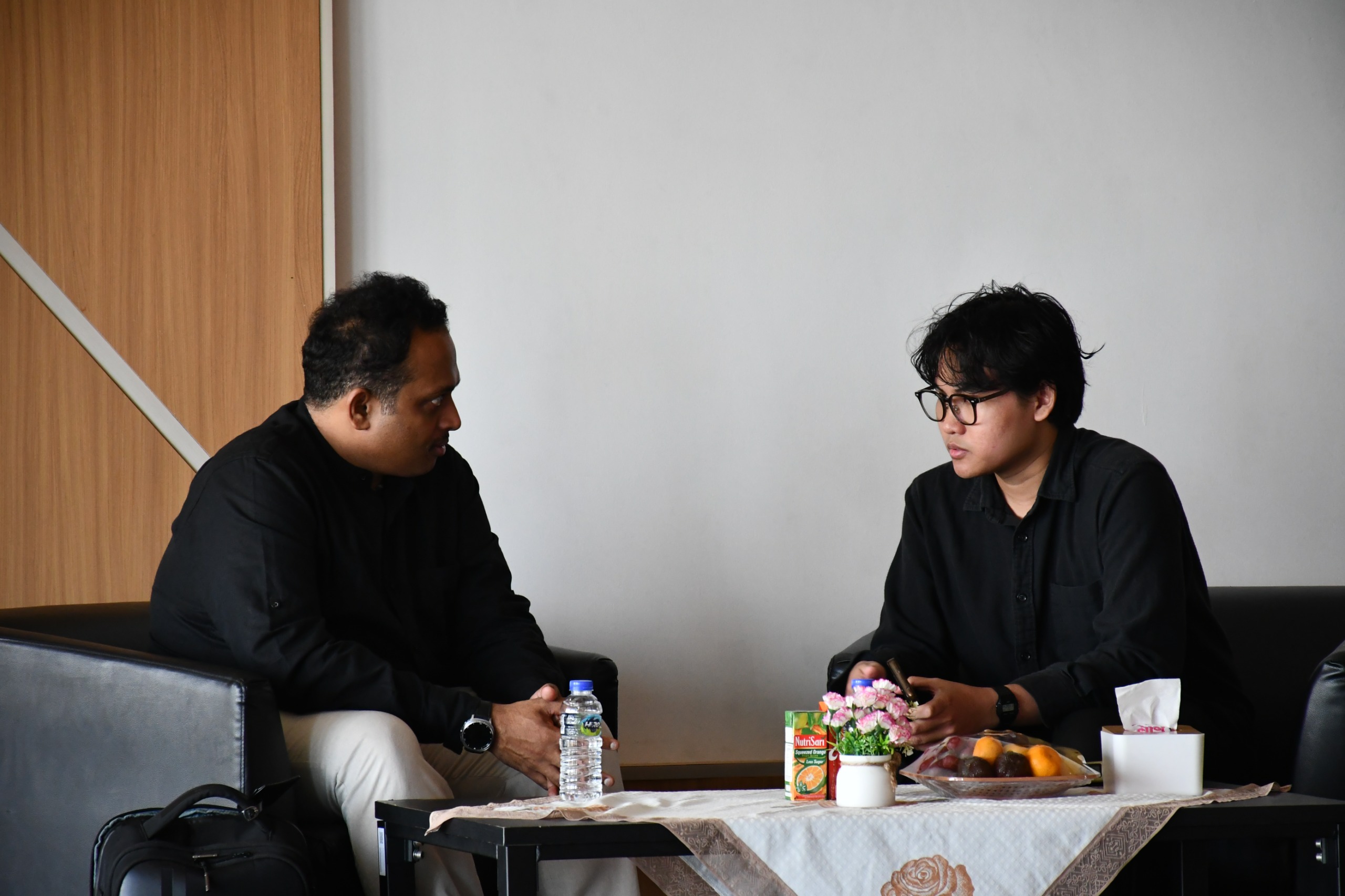
From left: Ganesh Neelakanta Iyer, Ph.D., and Athalla Barka Fadhil engage in a discussion during the question-and-answer session.
Ganesh Neelakanta Iyer, Ph.D., also encouraged students to begin their research journey within their own universities. “Approach lecturers at your university who are actively conducting research in your field of interest and ask to get involved in a small project. This is where you learn to think independently, unlike industrial internships, where you primarily follow instructions from supervisors,” he explained. When it comes to reading academic papers, he recommended finding highly cited publications through Google Scholar and reading them progressively, starting with the Abstract, Introduction, and Conclusion before moving on to the technical sections.
As a follow-up, Ganesh Neelakanta Iyer, Ph.D., encouraged students to prepare their applications ahead of the January 15 deadline. Applicants are required to select three prospective academic supervisors, whose profiles and publications can be reviewed through the department’s website or Google Scholar. “Make sure your research interests align with the research areas of your selected supervisors, as the initial screening is conducted directly by the respective faculty members,” he emphasized. He also recommended considering faculty members holding positions such as Assistant Professor, Associate Professor, or Senior Lecturer, as they generally have a greater need for research assistants. In addition, students are encouraged to send a cold email containing their CV, skills, and research interests to prospective supervisors before the application deadline.
Through this session, DTI ITS students gained a clearer understanding of pathways toward international research experiences, ranging from the SRI program to pursuing a Ph.D. at NUS. The experiences of Kevin and Farah are expected to inspire students by demonstrating that ITS students can compete on a global level. Moving forward, similar initiatives are expected to strengthen the research culture within DTI ITS while fostering closer academic ties with NUS, ensuring that research collaboration opportunities remain open for future students.
Contribution to the Sustainable Development Goals (SDGs)
- SDG 4: Quality Education, by providing DTI ITS students with insights into postgraduate study opportunities and international research experiences.
- SDG 9: Industry, Innovation, and Infrastructure, by strengthening the research culture and introducing students to fields such as computing, artificial intelligence, and cybersecurity.
- SDG 17: Partnerships for the Goals, by fostering academic collaboration between DTI ITS and NUS to expand research opportunities for students.
These contributions reflect the initiative’s commitment to advancing education and research collaboration, while opportunities to participate in the SRI program and pursue further studies at NUS remain accessible to students through a competitive selection process.
Reporter: Mutiara Diva
=================================================================
Information provided by :
Department of Information Technology
Website: its.ac.id/it
Instagram: its_teknologi_informasi
Youtube: Teknologi Informasi ITS