DTI ITS Equips Students to Face the AI Era through the Mobile Builders’ Guide Guest Lecture
Published on
Friday, 6 November 2026
Surabaya, IT Journalistic – The Department of Information Technology at Institut Teknologi Sepuluh Nopember (ITS) held a guest lecture themed “MBG: Mobile Builders’ Guide” on Thursday (5/11/2026). The event, which took place from 07:00 to 10:00 WIB in the Auditorium of ITS Tower 2, was attended by students taking the Mobile Programming course. Through this activity, students were invited to understand the role of AI in mobile application development while preparing themselves for the professional world.
The guest lecture featured Abdullah Faqih Septiyanto, S.Kom., M.Kom., a Researcher and Chief Technology Officer (CTO) of CV. Swandhana, as the speaker. In his presentation, Abdullah Faqih explained that the way mobile applications are built continues to evolve, starting from the native era with Java/Kotlin and Swift, the cross-platform era with Flutter and React Native, to the current era of AI-assisted development. Nevertheless, the role of a developer remains essential. According to him, AI is not a replacement, but rather a working partner. While AI can help write code, it is the developer who determines what application to build, who it is for, and ensures the results are correct. “AI will not replace developers, but developers who use AI will replace those who do not,” read the message in his presentation material.
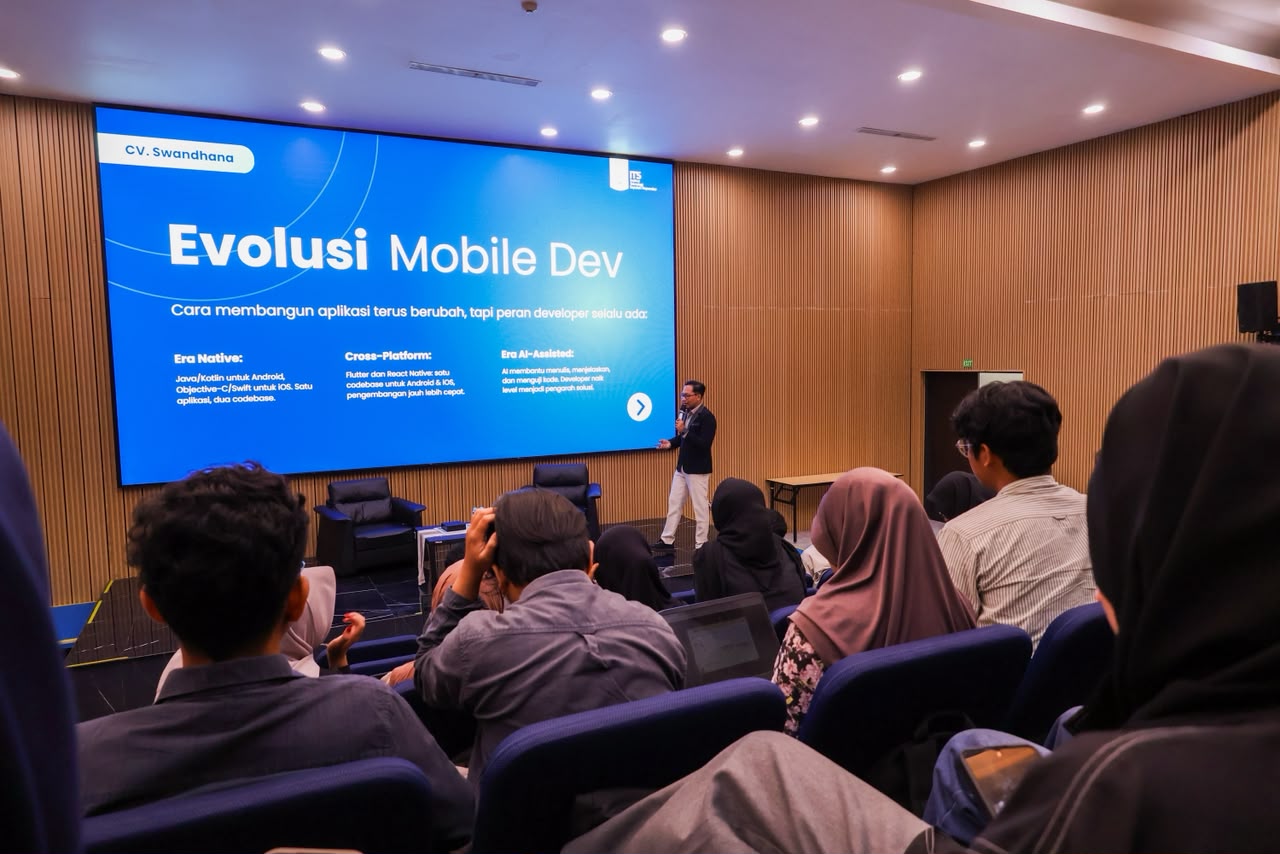
Abdullah Faqih Septiyanto, S.Kom., M.Kom., explains the evolution of building mobile applications, from the native era to the AI-assisted era, to the students.
Abdullah Faqih also reminded the audience that the output of AI is only as good as the user’s understanding. Without comprehension, AI might suggest non-existent libraries or expose API keys directly in the code. On the other hand, job opportunities in this field are still wide open. He mentioned that Indonesia needs around 9–12 million digital talents by 2030, while the current supply is only about 3 million (estimated figure). However, job interviews for junior positions often involve live coding without AI, so foundational knowledge must still be mastered.
During the Q&A session, Faqih Ridho, a 2024 Information Technology student, raised two questions. First, he highlighted how building mobile applications now feels instant thanks to AI, yet data security aspects are often poorly understood, especially in applications storing vast amounts of personal data. He asked how to build secure applications and what penetration testing methods are typically used. Responding to this, Abdullah Faqih stated that security testing is basically done first by the internal team, then followed by collaborating with a more professional penetration testing company. According to him, the cost of these services generally depends on the number of vulnerabilities found.
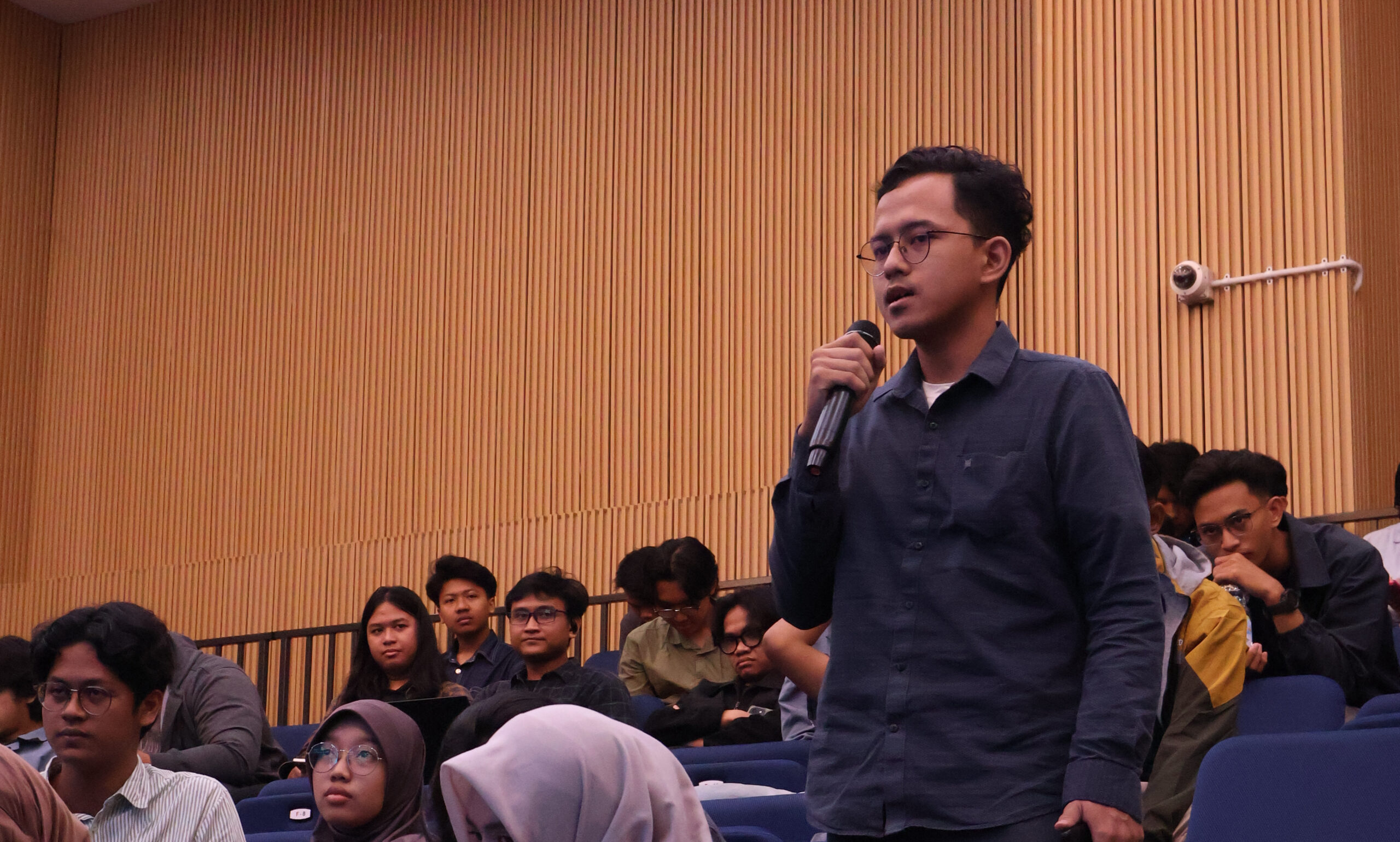
Faqih Ridho, a 2024 Information Technology student, asks a question to the speaker during the Q&A session.
Faqih Ridho’s second question concerned project pricing in the AI era, given that development feels increasingly easier. He asked how to determine the value of a project. Abdullah Faqih explained that for projects done by students, the price is roughly Rp1-2 million for simple projects and Rp4-5 million for more complex ones, considering students’ skills are still limited. At the professional level, prices are calculated based on features classified by difficulty and development time. The faster the target completion, the more expensive the price.
After the event, Angga Firmansyah, a 5th-semester Information Technology student from the 2024 cohort, admitted that his view on AI not being able to replace developers grew even stronger after attending the guest lecture. “What AI cannot think of is the empathetic approach to humans, and that requires organic thinking from humans themselves,” he expressed. According to him, this guest lecture validated his thoughts because the speaker emphasized the importance of learning programming fundamentals and the mindset required to design digital solutions. The most memorable part for him was the opportunity to understand a CTO’s way of thinking, including the skills that need to be mastered and the career journey from a junior developer to a CTO. “We get to know the perspective of someone who holds significant responsibilities,” he explained.
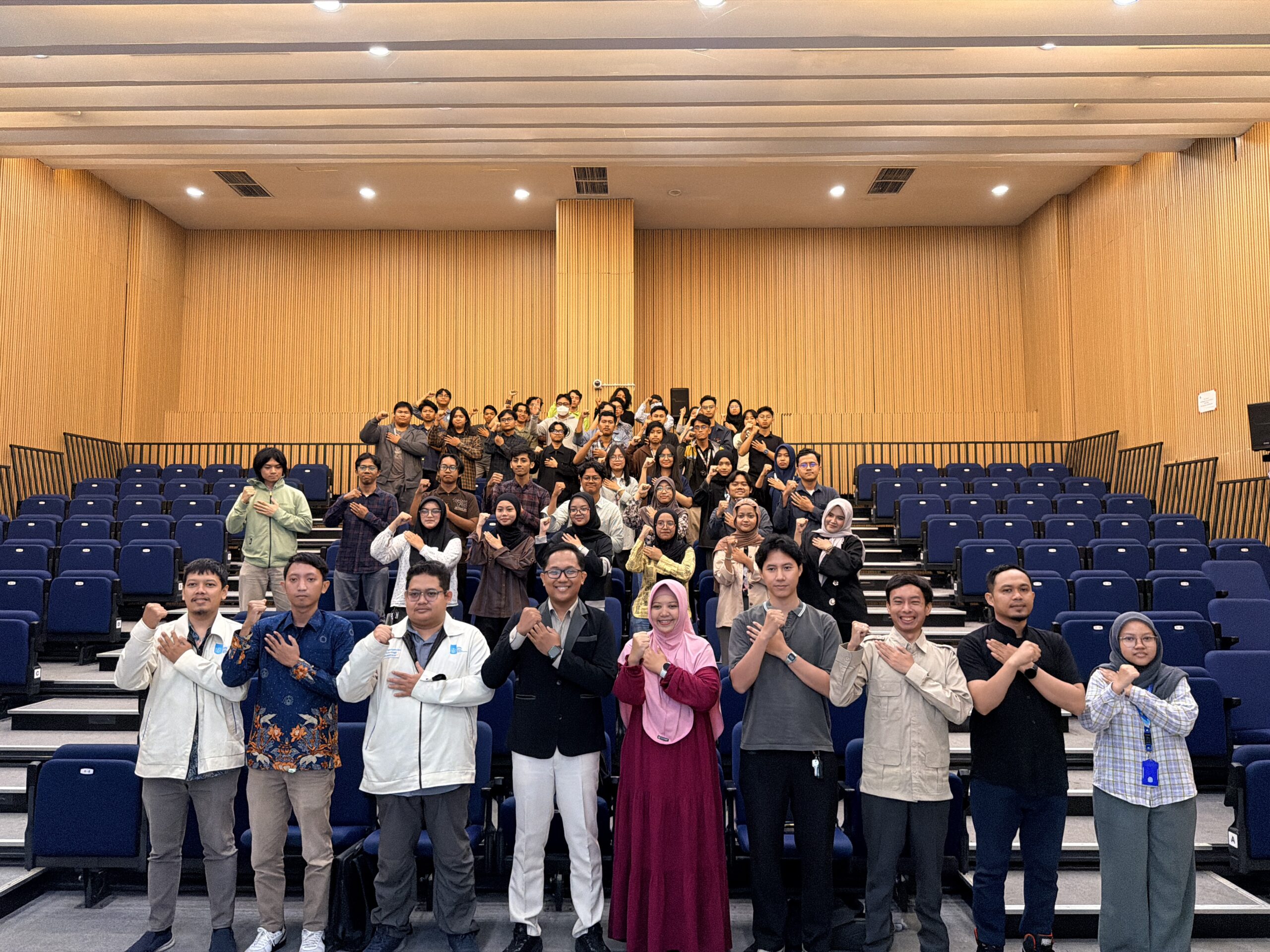
A group photo session with the speaker, lecturers, and student participants as the closing of the event series.
As a follow-up, Abdullah Faqih challenged the students to build a small application within the week, using AI as an assistant, and ensuring every single line of code is understood. He also encouraged students to get used to real-world workflows during their studies, such as using Git, conducting peer code reviews, and treating assignments like client briefs.
Contribution to Sustainable Development Goals
- SDG 4: Quality Education, by equipping students with AI literacy, fundamental programming comprehension, and real-world work practices so their competencies align with industry needs.
- SDG 8: Decent Work and Economic Growth, through the presentation of job opportunities, digital talent demands, and insights into project pricing for aspiring mobile developers.
This connection shows the direction of the contribution towards students’ education and work readiness, while students’ career opportunities in mobile development can be explored further.
Reporter: Mutiara Diva
=================================================================
Information provided by:
Department of Information Technology
Website: its.ac.id/it
Instagram: its_teknologi_informasi
Youtube: Teknologi Informasi ITS