Surabaya, IT Journalistic — The community service team from the Department of Information Technology (DTI) at the Sepuluh Nopember Institute of Technology (ITS) has developed AgriSense Go, a portable soil testing device based on the Internet of Things (IoT) and edge intelligence to assist shallot farmers in Kare Village, Madiun Regency. This initiative, which involves the Ora Obah Ora Mamah Farmers’ Group, aims to make it easier for farmers to assess soil conditions and determine water and fertilizer needs based on data—even in areas with limited internet access.
AgriSense Go was developed as an improvement on a previous community service program that used a permanent IoT monitoring system in the field. Based on evaluation results, the previous system could only measure soil conditions at a single point and was still dependent on an internet connection. However, soil conditions can vary from one plot to another. As a result, farmers still relied on experience and visual observation to determine when to water and apply fertilizer. With AgriSense Go, measurements can now be taken at multiple points using a single portable device.
To use it, farmers simply insert the sensor into the soil to measure moisture, acidity (pH), and the levels of nitrogen, phosphorus, and potassium (NPK). The data is then processed directly by the ESP32 microcontroller using edge intelligence technology to generate recommendations for action. If soil moisture is below the plant’s requirements, the device will recommend watering. Meanwhile, the pH readings are used to determine whether the soil’s acidity is appropriate or needs adjustment. Regarding NPK parameters, the device provides information on whether specific nutrients still need to be added through fertilization. All measurement results and recommendations can be displayed in about one minute without requiring an internet connection. If an internet connection is available, the measurement data can also be sent to a web dashboard to monitor the history of soil conditions.
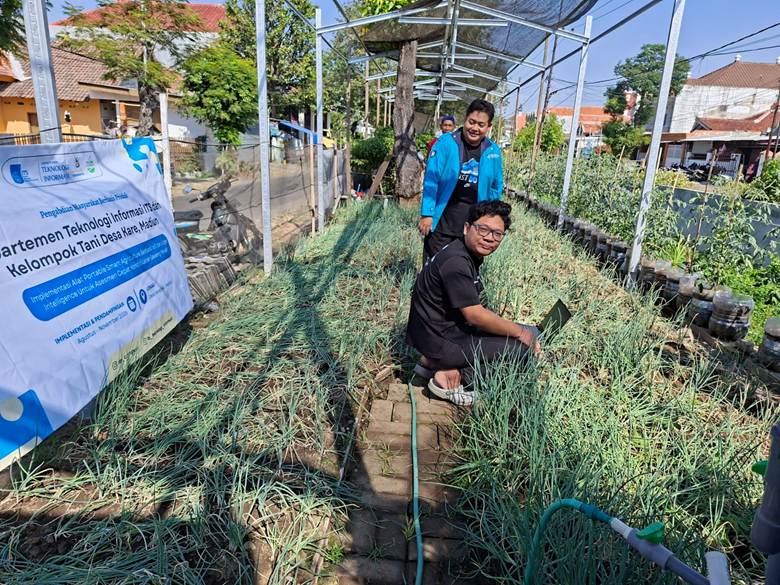
Taufiq Choirul Amri, S.Tr.T., M.Kom., along with Dani Wahyu Anak Ary, observed the condition of the shallot fields as part of the AgriSense Go trial.
In practice, AgriSense Go has been used by 10 members of the Ora Obah Ora Mamah Farmers’ Group. This tool allows farmers to obtain real-time information on soil conditions without having to constantly conduct laboratory tests. The program has also produced a number of outputs, including the AgriSense Go device, a journal article in Sewagati, a video documenting the activities, and the registration of intellectual property rights (IPR).
The development of AgriSense Go involved a team of faculty members from the ITS Department of Information Technology, led by Fuad Dary Rosyadi, M.Kom., along with Dr. Henning Titi Ciptaningtyas, Taufiq Choirul Amri, S.Tr.T., M.Kom., Hafara Firdausi, M.Kom., and Dr.techn. R.V. Hari Ginardi, as well as five students: Nisrina Atiqah Dwiputri Ridzki, Dani Wahyu Anak Ary, Farand Febriansyah, Veri Rahman, and Malvin Putra Rismahardian. The students were involved in various stages, ranging from device assembly, sensor installation, and microcontroller configuration to data processing, as well as training and mentoring farmers. The development of AgriSense Go involved a team of faculty members from the ITS Department of Information Technology, led by Fuad Dary Rosyadi, M.Kom., along with Dr. Henning Titi Ciptaningtyas, Taufiq Choirul Amri, S.Tr.T., M.Kom., Hafara Firdausi, M.Kom., and Dr.techn. R.V. Hari Ginardi, as well as five students: Nisrina Atiqah Dwiputri Ridzki, Dani Wahyu Anak Ary, Farand Febriansyah, Veri Rahman, and Malvin Putra Rismahardian. The students were involved in various stages, ranging from device assembly, sensor installation, microcontroller configuration, and data processing to training and mentoring farmers.
Through this activity, students learned that technology successfully developed in the laboratory may not necessarily be immediately suitable for field conditions. The development of AgriSense Go taught them the importance of designing technology based on user needs and actual environmental characteristics. Meanwhile, the Ora Obah Ora Mamah Farmers’ Group, led by Supriadi, provided a testing site, tested the device firsthand, and offered feedback to refine it.
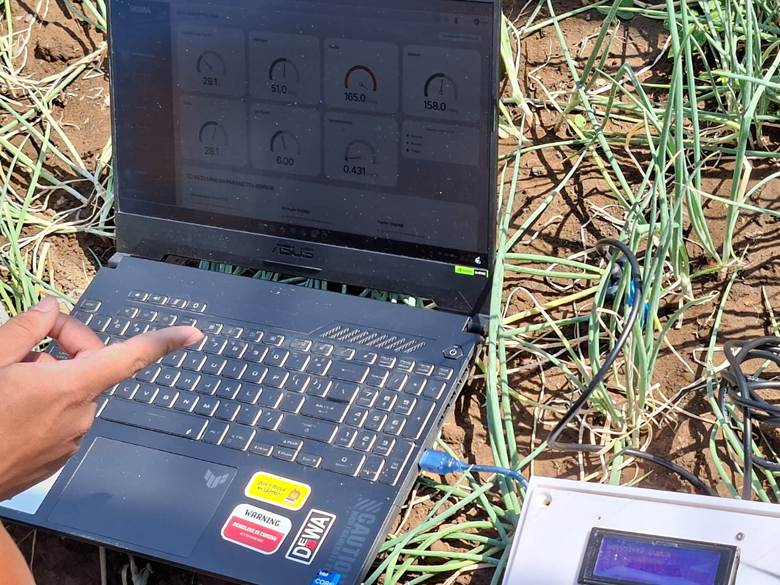
The ITS DTI community service team, together with its farmer partners, tested AgriSense Go by monitoring soil data on a digital dashboard.
Positive feedback was also expressed by the farmers who benefited from the program. The community service team reported that partner farmers felt assisted by the technology, which simplifies the assessment of shallot field conditions. A memorable experience during this activity was witnessing the enthusiasm of farmers who have a strong desire to grow but previously did not know how to utilize technology in their farming activities. Through AgriSense Go, farmers are being introduced to data-driven decision-making, rather than relying solely on intuition or estimates.
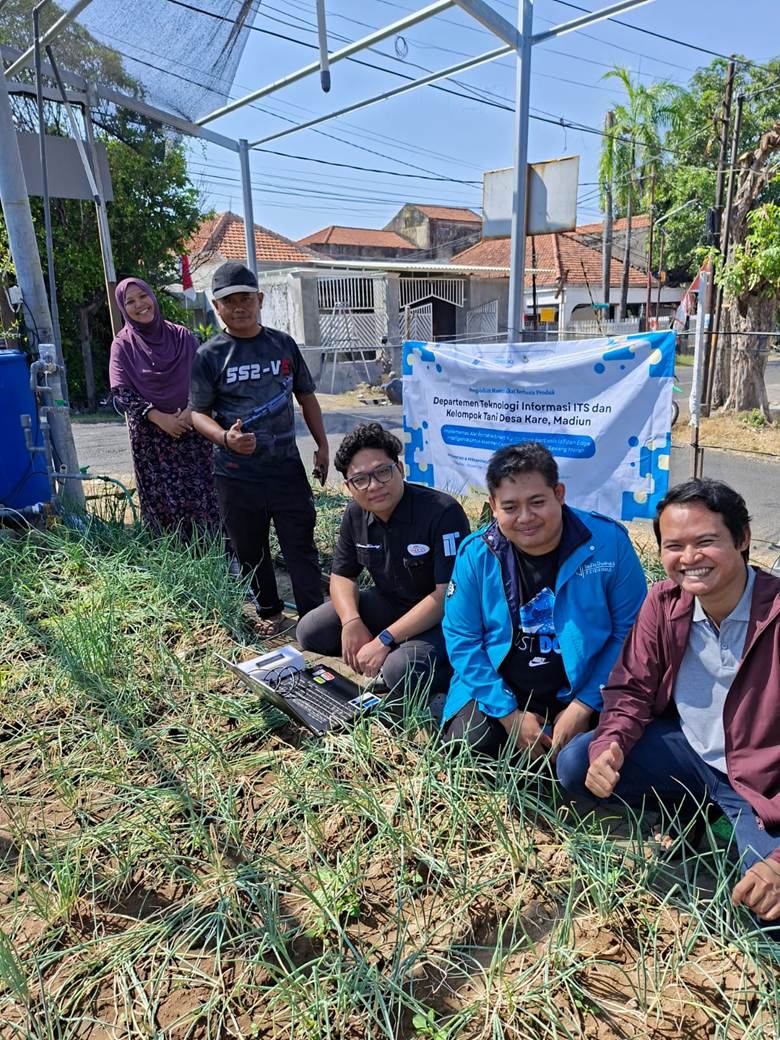
The ITS DTI community service team, together with their partner, the Ora Obah Ora Mamah Farmers’ Group, testing AgriSense Go. From left to right: Dr. Henning Titi Ciptaningtyas, Supriadi (farmer partner), Dani Wahyu Anak Ary, Taufiq Choirul Amri, S.Tr.T., M.Kom., and Fuad Dary Rosyadi, M.Kom.
Moving forward, the community service team will continue to provide technical assistance and equipment maintenance so that farmers can operate AgriSense Go independently. The team also plans to develop artificial intelligence (AI)-based features for predicting irrigation and fertilizer needs, integrate weather data, and create a mobile app. In addition, there is an opportunity to replicate the implementation of this technology among other farmer groups in the Madiun region and surrounding areas.
Contributions to the Sustainable Development Goals
- SDG 2: Zero Hunger, through the use of smart agricultural technology to help farmers optimize the care of their shallot crops and support improved agricultural productivity.
- SDG 9: Industry, Innovation, and Infrastructure, through the development of AgriSense Go—an IoT- and edge intelligence-based technological innovation capable of operating in areas with limited internet connectivity.
- SDG 12: Responsible Consumption and Production, through the use of soil condition data as a basis for decision-making regarding water and fertilizer use to ensure greater precision and reduce potential resource waste.
This connection highlights ITS’s contribution to supporting sustainable agriculture through the implementation of technological innovations tailored to the community’s needs. Meanwhile, the development of AI-based features and the expansion of AgriSense Go’s use to other farmer groups remain opportunities worth exploring further.
=================================================================
Reporter: Maitasya Rohmatul Ula
This information was provided by:
ITS Department of Information Technology
Website: its.ac.id/it
Instagram: @its_teknologi_informasi
YouTube: ITS Information Technology