
About

Published on
Saturday, 1 August 2026
A team of Institut Teknologi Sepuluh Nopember (ITS) Surabaya students has claimed 1st Place at the SWAG Business Case Competition 2026, organized by Universitas Gadjah Mada (UGM), with a business solution for the cereal brand Oriflakes.
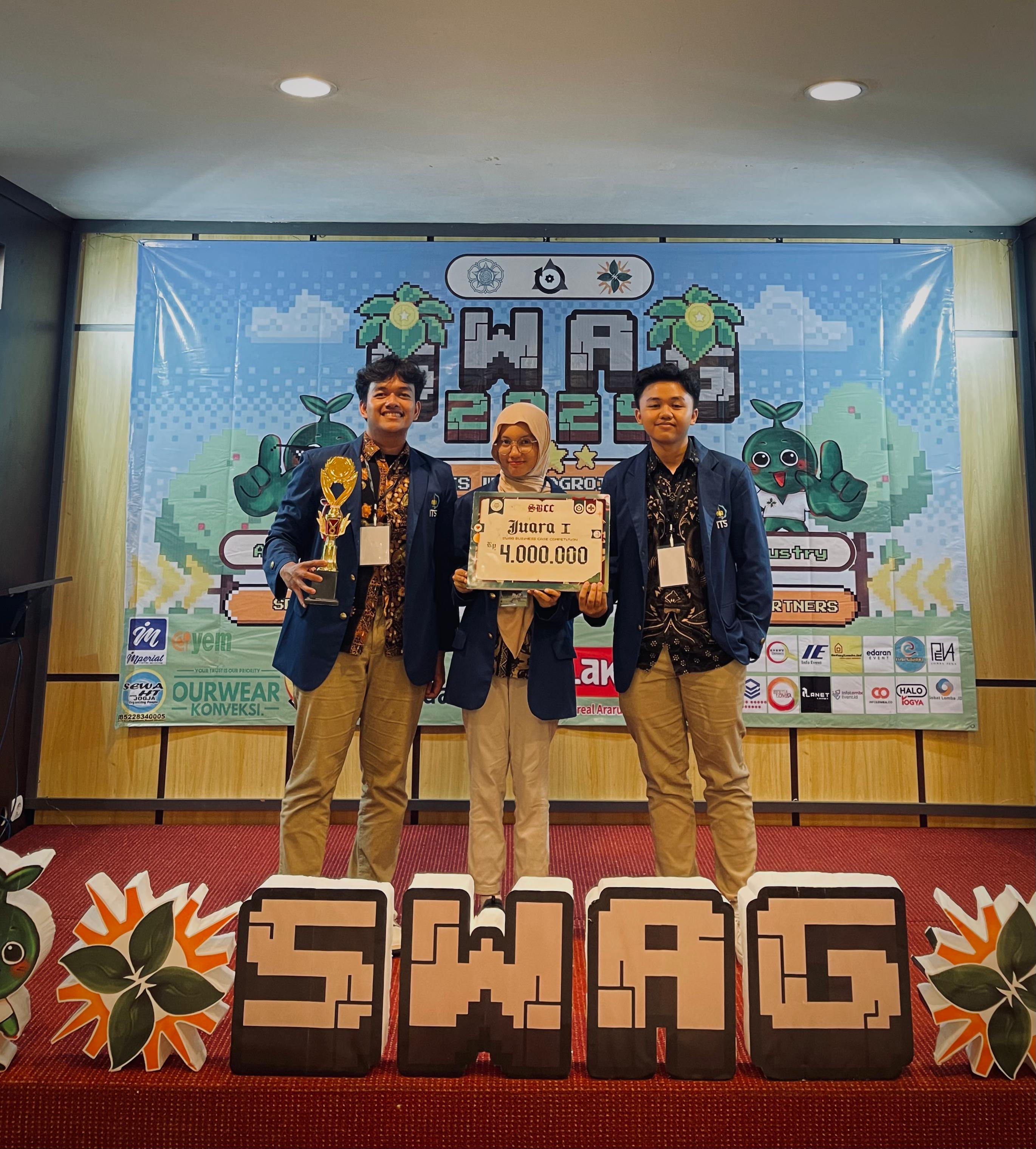
Surabaya, FT-EIC ITS – A team of students consisting of Akhtar Ibrahim, Kaka Agastya Herlambang Wahyudi, and Salsa Aulia Azzahra Havenanda won 1st Place at the SWAG (Success With Agroindustry) Business Case Competition, a national-level competition in the agroindustry field organized by the Student Association of Agro-Industrial Technology, Universitas Gadjah Mada (UGM). All three are students of Institut Teknologi Sepuluh Nopember (ITS) Surabaya. This achievement was made despite the team having only about one week to prepare. The competition featured a real case study from Oriflakes, a cereal brand made from arrowroot tuber, as its case collaborator.
The challenge given to participants was quite broad. Participants were asked to develop a strategy for Oriflakes to bounce back and reclaim its position as market leader, ranging from strategies to survive amid intense competition, creating differentiation from competitors, to formulating an international market expansion plan. Teams were required to provide realistic and implementable business solutions.
What made this achievement even more remarkable was how limited the team’s preparation time was. They only learned about the competition on July 2, while registration for Batch 2 closed the very next day, on July 3. That same day, the team registered and immediately began reading and working on the case study. From then on, the team worked at an intense pace, discussing almost every day through chat and setting aside time for Zoom calls at night. Each member worked on their assigned section, then in the evening the whole team gathered to discuss the results, provide feedback, evaluate weaknesses, and divide the next tasks. This pattern continued until the paper was finally submitted on July 10.
From this lengthy research and discussion process emerged the O.R.I Strategy, namely Optimization, Repositioning, and Infiltration, which ultimately helped bring the team to victory. Optimization focused on increasing consumer engagement through digital channels. Repositioning focused on refreshing the brand’s image and communication to be more relevant to the target market, particularly Gen Z. Meanwhile, Infiltration focused on market expansion through a reseller community, offline activations such as booths at Car Free Day events, and expansion into Malaysia through Shopee Cross Border. Each proposed solution was also backed by supporting evidence, including consumer research findings, competitor analysis, and market trends, complete with implementation plans, targets, potential impact, as well as risks and mitigation strategies.
One of the team members, Salsa Aulia Azzahra Havenanda, explained that the biggest challenge they faced was the very short working time. Within about one week, the team had to understand the case study, gather data, identify the root problem, develop solutions, and complete the entire paper.
“Finding the root problem wasn’t easy either, since there were many interconnected issues. Some of the data we needed was also quite difficult to find. To deal with this, we conducted research from various sources, compared Oriflakes with its competitors, and discussed almost every night through Zoom,” said Salsa.
Although roles were not strictly divided, each team member had their own focus. Akhtar, as team leader, mostly guided the discussions, ensured the team’s train of thought stayed aligned with the case’s objectives, and coordinated each member’s work. Kaka focused on slide design and visualization in the paper to make the solutions easier to understand. Meanwhile, Salsa mostly handled research and parts of the paper’s content, from gathering data and building analysis to helping develop the solutions. At the start, all members read the case study independently before discussing together to determine the core problem to be solved. After that, they reviewed the paper’s structure, divided the sections to work on, and every night reconvened to review each other’s work.
The combination of hard work, thorough research, and realistic solutions ultimately brought this ITS Surabaya student team to victory as 1st Place winners. For them, this achievement proves that limited time can be overcome with solid collaboration and a strong commitment to the quality of the proposed solutions.
“Leadership isn’t just about being the team leader, but also about taking initiative, helping teammates who are struggling, and making sure the team’s goals stay on track. Many ideas that started out simple eventually became more refined after being discussed together from various perspectives,” Salsa added.
From their experience winning 1st Place at the SWAG Business Case Competition, the team summarized four important skills that students who want to join business case competitions should have: problem solving, to identify issues and develop realistic solutions; research and data processing skills, so that solutions are backed by strong evidence; leadership and teamwork, to bring together various ideas into one cohesive solution; and public speaking, so that a well-developed solution can be delivered clearly, in a structured way, and convincingly in front of the judges.