About
Published on
Wednesday, 2 September 2026
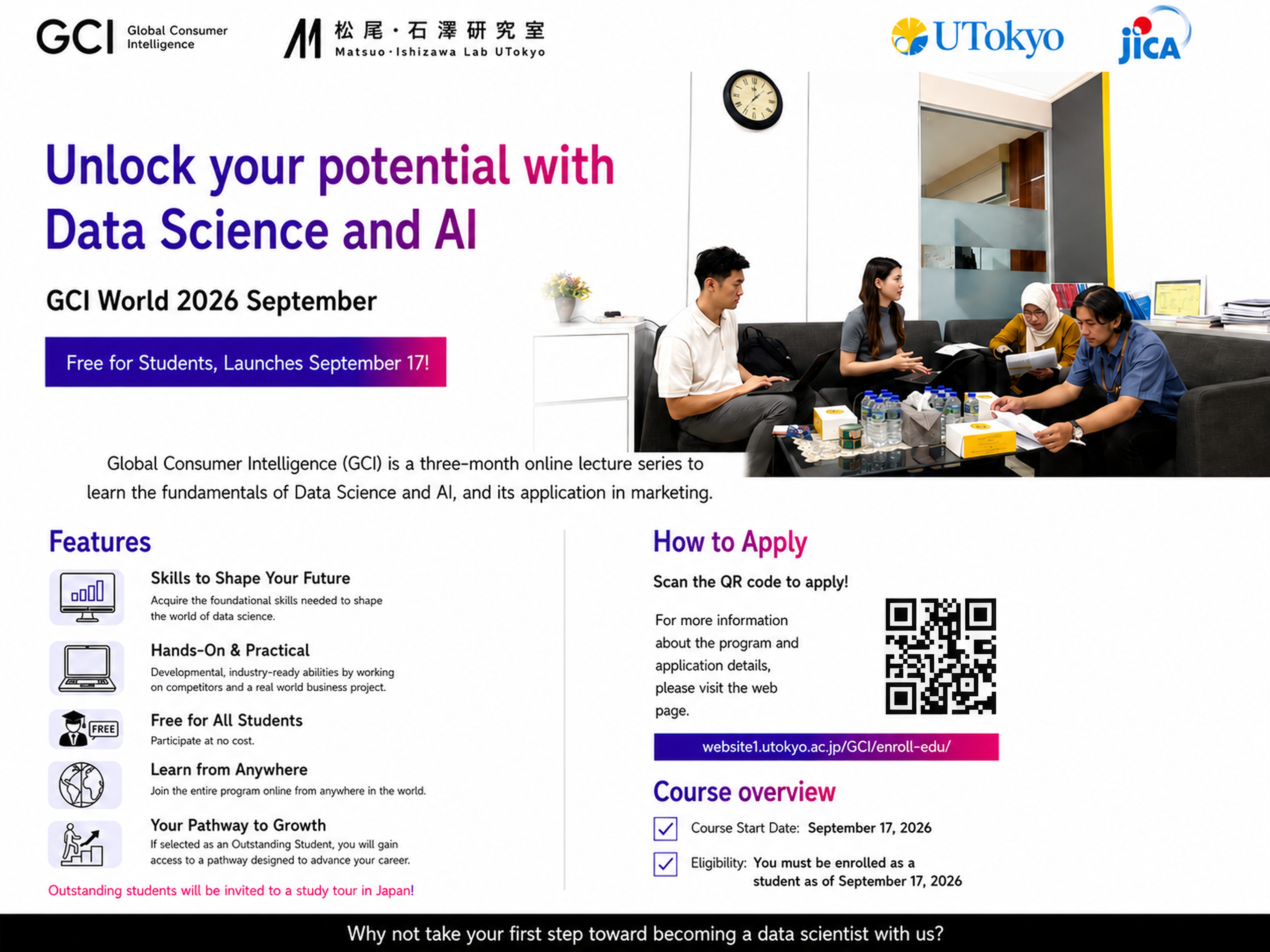
The University of Tokyo, through the Matsuo Iwasawa Laboratory, has once again opened registration for its data science and artificial intelligence (AI) learning program called GCI World 2026, a free online course supported by the Japan International Cooperation Agency (JICA) that has reached tens of thousands of students from around the world.
Surabaya, FTEIC ITS – Global Consumer Intelligence (GCI) is an online lecture program developed by the Matsuo Iwasawa Laboratory, part of the Graduate School of Engineering at the University of Tokyo. The program has been running in Japan since 2014 and has been taken by more than 30,000 students within Japan through a 14-week online course.
In 2025, the Matsuo Iwasawa Laboratory launched an English-language version of the course called GCI Global as a pilot program. This pilot program was joined by more than 7,700 students from 32 countries and 461 universities, with a total of 14 classes offered, and also held in-person lectures at a number of universities with high retention rates, including in Vietnam, Malaysia, South Africa, Zimbabwe, the Philippines, and Bangladesh.
Building on the experience and insights gained from that pilot program, it was then officially launched under the name GCI World starting in April 2026. The response received was extraordinary. More than 25,000 students from more than 2,900 universities in more than 120 countries and regions, including countries in Africa and ASEAN, registered to take the course. This number of participants was more than three times higher than the previous pilot period, with the following breakdown:
GCI World provides a hands-on learning experience, covering an understanding of the purpose of studying data science, the basics of Python programming, machine learning, through to the practical application of data in a business context. The program is designed to help students take their first step toward a career as a data scientist, entirely free of charge.
The GCI World September 2026 program is scheduled to begin on 17 September 2026, running intensively for three months, consisting of weekly lectures lasting 90 to 120 minutes, homework assignments, competitions, and a final project. The curriculum covers 14 sessions as follows:
| Week 1: Introduction to Data Science | Week 8: Feature Engineering |
| Week 2: Data Processing Using Numpy | Week 9: Application of Data Science in Marketing |
| Week 3: Data Cleaning Using Pandas | Week 10: SQL |
| Week 4: Data Visualization with Matplotlib | Week 11: Unsupervised Learning |
| Week 5: Supervised Learning | Week 12: Time Series Analysis |
| Week 6: Model Evaluation | Week 13: Guest Session |
| Week 7: Competition and Final Project Tutorial | Week 14: Special Content |
Live lecture sessions are held every Thursday from 11:00 to 12:30 UTC, with the option to watch a recording within one week for participants unable to attend live.
Before the main classes begin, the organizing team also provides a special additional session for students who are complete beginners in Python, in the form of recorded videos, presentation slides, and practice files. In addition, teaching assistants who are GCI alumni also offer online consultation hours, while a Slack community is provided to support interaction among participants throughout the program. In terms of technical requirements, participants need a computer and a stable Wi-Fi connection, as participation using only a smartphone is not recommended. The program uses the Zoom and Slack platforms, as well as Google services such as Google Drive, Google Forms, and Google Colaboratory.
Participants must be active students as of 17 September 2026, including those in doctoral, master’s, bachelor’s, diploma, vocational/technical programs, as well as secondary education such as high school/junior high school. Non-degree students may still register as long as they hold an official student ID card issued by their university or an equivalent institution. Working professionals who also hold student status, such as part-time students, are also eligible, as are students who will graduate during the course period.
On the other hand, the following categories are not eligible to register:
1. Continuing education participants not enrolled in a degree program
2. Students of language course institutions or non-accredited institutions
3. Working professionals who do not hold student status
Documents required as proof of student status as of 17 September 2026 include a student ID card or an official certificate of active enrollment. If a student ID card is unavailable, participants may upload alternative documents such as course registration confirmation, a screenshot of the official university portal or a verification email, an acceptance letter stating the start date of study, or other official documents from the institution proving active status.
The program registration deadline is set for 10 September 2026 at 07:00 UTC, with a final cutoff at 14:00 UTC on the same date, while the ID registration deadline is set for 7 September 2026 at 07:00 UTC. Participants are advised to register well before the deadline to allow sufficient time for pre-course preparation. For applicants who are deemed eligible, an acceptance notification along with pre-course learning materials will be sent within 2 to 3 weeks after registration.
The registration process consists of four stages:
1. Email registration using a university email address to speed up the verification process. Participants will receive an email containing a link to the ID registration form. Note that not all school domains are accepted; if an institutional email cannot be used, applicants may use a special option for those without a school email.
2. Creating an Omnicampus ID as the course management system, by attaching a personal Gmail address along with a student ID card or other document that can verify active enrollment status. Registration will be reviewed by an admin before approval, and an image of the student ID card must be attached, otherwise an Omnicampus account cannot be created.
3. Logging into the Omnicampus system using the login URL, ID, and password sent via email.
4. Selecting the program GCI World September 2026 from the list of available courses on the Omnicampus homepage.
Participants who complete this program will receive a certificate of completion, with the total program equivalent to approximately 22 teaching hours. Graduation assessment is based on the following four components, each of which must meet the required standard or number of submissions: attendance surveys, homework assignments, a final project, and a competition.
Participants are also advised to check with their home institution regarding the possibility of having this course recognized as a credit-bearing course, in accordance with each institution’s policy. Under ITS’s internal policy, this course has the potential to be converted into Extracurricular Student Credit Units (SKEM).
One of the program’s main attractions is the opportunity for outstanding students to be selected as an Outstanding Student and invited to join a special five-day study tour to Japan, fully sponsored by Matsuo Lab. During the visit, participants have the opportunity to directly visit Matsuo Lab and a number of Japanese companies, attend a dinner with JICA and the Japanese government, and experience Japanese culture firsthand. Note that students who have previously taken this course are no longer eligible to be selected as an Outstanding Student in the following period.
The GCI World program is part of a broader educational ecosystem developed by the Matsuo Iwasawa Laboratory, which as a whole offers more than 30 AI-related education programs across four main areas: Web Engineering and Business Model, AI Engineering, World Models/Large Language Models/Physical AI, and Data-driven Entrepreneurship Exercise, all offered free of charge and online for students of various academic levels and backgrounds.
The program is developed by the Matsuo Iwasawa Laboratory, led by Prof. Yutaka Matsuo, whose expertise lies in AI, particularly deep learning and web mining. According to the laboratory’s official presentation materials, Prof. Matsuo has published more than 20 books and over 300 journal and conference papers, with an h-index of 60 and more than 30,000 citations. In addition to his active role in academia, he also serves as Chairman of the AI Strategy Expert Committee at Japan’s Cabinet Office, a member of Japan’s Growth Strategy Council under the Prime Minister, an Outside Director at SoftBank and Panasonic, and Founder and Director of the Japan Deep Learning Association. The Matsuo Lab community itself consists of more than 400 members, spanning the Matsuo Iwasawa Laboratory at the University of Tokyo and Matsuo Institute, Inc., a company founded in 2020 focused on industry-driven research and development.