About
Published on
Wednesday, 29 July 2026
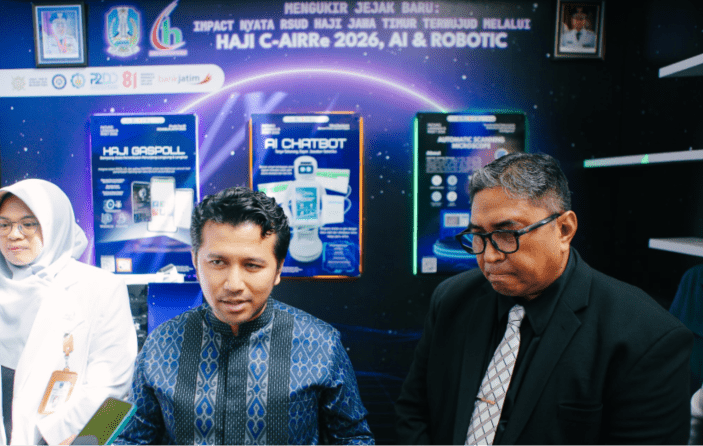
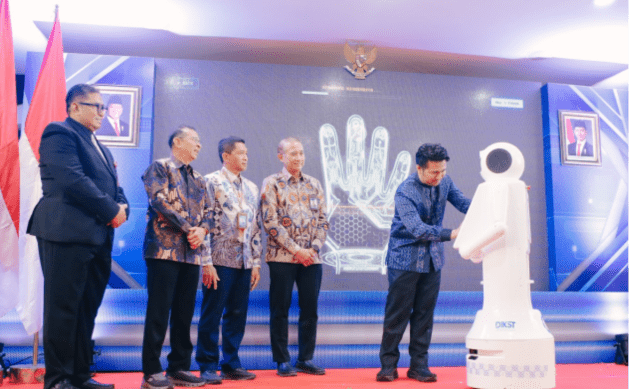
Institut Teknologi Sepuluh Nopember (ITS), together with RSUD Haji Regional Hospital of East Java Province and Universitas Airlangga (Unair), has officially launched three artificial intelligence and robotics-based innovations under the HAJI C-AIRRe ecosystem (Collaborative Artificial Intelligence and Robotic Research Innovation Ecosystem in Healthcare). The three innovations, namely AI MINA, iBrain2U, and Robot RAISA, were developed to support the digital transformation of services at RSUD Haji Regional Hospital of East Java Province.
Administrative processes remain one of the major challenges in healthcare services in Indonesia. In many hospitals, BPJS (national health insurance) claim submissions still frequently experience pending or rejected status due to incomplete medical documents or inconsistencies between clinical diagnoses and supporting evidence. In addition to slowing down claim disbursement, this condition also increases the workload of healthcare workers, who still have to carry out the verification process manually.
To address this challenge, RSUD Haji Regional Hospital of East Java Province, together with Institut Teknologi Sepuluh Nopember (ITS), developed the Modified Intelligent Non-disputed Assistant (AI MINA), an artificial intelligence system based on Sovereign AI designed to help validate medical documents automatically and in real time.
AI MINA integrates various technologies, including Optical Character Recognition (OCR), Natural Language Understanding (NLU), and Large Language Model (LLM). Through this combination of technologies, the system is able to read medical documents, understand the context of a diagnosis, cross-check the information with laboratory, radiology, and medical procedure results, and then validate its conformity based on ICD coding rules and BPJS regulations.
The presence of AI MINA has brought about a fundamental change in the claim verification process. Whereas staff previously needed around 20 minutes to check a single document, the process can now be completed in less than two minutes. This change not only improves the hospital’s operational efficiency, but also shifts the verification process from being corrective to preventive in nature. Potential errors can be detected early, before documents are submitted to BPJS.
In addition to speeding up the verification process, AI MINA is also equipped with a real-time monitoring dashboard. Through this feature, hospital leadership can monitor claim performance, identify potential issues at an earlier stage, and make data-driven decisions to improve service effectiveness.
The benefits of AI MINA are felt not only by the hospital, but also by healthcare workers and the community. For healthcare workers, the system helps reduce repetitive administrative work, improves the accuracy of medical documentation and ICD coding, and minimizes the risk of errors in submitting BPJS claims. As a result, doctors and healthcare workers can focus more on providing care to patients.
Meanwhile, the community is expected to benefit from faster, more accurate, and more efficient services. The reduction in the number of pending or rejected claims also supports the hospital’s financial stability, allowing healthcare services to continue sustainably. On the other hand, patient data security remains guaranteed, as all data processing is carried out on a local server (on-premise) without relying on external cloud services.
Nevertheless, the implementation of AI MINA still faces a number of challenges. Integration with the Hospital Management Information System (SIMRS), variations in clinical documentation styles among doctors, changing BPJS regulations, and the need to improve healthcare workers’ digital literacy are among the aspects that require attention.
To address these challenges, implementation is carried out in stages, starting with the provision of local server infrastructure, training the AI model using hospital data, integration with SIMRS/H3IS, conducting User Acceptance Testing (UAT), as well as regular monitoring and evaluation. Ongoing training, the development of standard operating procedures (SOPs), and the formation of a super-user team in each unit are also important parts of ensuring the system can be utilized optimally.
Looking ahead, the collaboration between ITS, RSUD Haji Regional Hospital of East Java Province, and Universitas Airlangga is expected to give rise to artificial intelligence innovations that are increasingly adaptive to healthcare service needs. Synergy between technology development, clinical experience, and academic support is expected to produce solutions that not only improve the quality of BPJS claim verification, but also drive the digital transformation of hospitals in Indonesia.
AI MINA is also expected to be replicated in various hospitals as a model for the implementation of Sovereign AI in the healthcare sector. Through the use of technology that is secure, efficient, and oriented toward improving service quality, AI MINA has the potential to become one of the strategic steps in supporting the transformation of national healthcare services.
The development of artificial intelligence (AI) technology presents major opportunities to support modern healthcare services. One of the innovations developed in the healthcare field is iBrain2U, an intelligent system based on Deep Learning designed to help analyze brain disorders through Magnetic Resonance Imaging (MRI) images.
iBrain2U is a medical image analysis system developed to assist in the identification and classification of various brain disorders. The system utilizes Deep Learning and machine learning technology to process MRI image data, enabling it to provide supporting information for medical personnel in the diagnostic process.
The development of iBrain2U was driven by the need to improve efficiency in the process of analyzing brain MRI images. Until now, MRI examinations have required a careful interpretation process carried out by doctors. With the support of AI technology, iBrain2U was developed as a clinical decision support system (Clinical Decision Support System) that assists doctors in conducting analysis, rather than replacing the doctor’s role in determining the final diagnosis.
iBrain2U works by having a doctor input a patient’s MRI image into the system. The system then performs an analysis process using an AI model to predict the type of brain disorder present in the image. The analysis results are presented as a disease classification along with the probability level of the AI’s prediction.
One of the main capabilities of iBrain2U is classifying several types of brain disease. Based on its development, the system has been designed to help identify four types of brain disorders, namely stroke, brain tumor, epilepsy, and Alzheimer’s disease. In addition to classification, the system has also been developed to indicate the location of the affected area within the analyzed MRI image slices.
In addition to its AI-based analysis capabilities, iBrain2U also features incremental learning. This feature allows the system to continue learning from the data it processes, so that its analytical capabilities can improve as more data is used. With this capability, the system is designed to be more adaptive to the needs of developing technology-based healthcare services.
The development of iBrain2U was carried out by Institut Teknologi Sepuluh Nopember (ITS) through a research team led by Prof. Dr. I Ketut Eddy Purnama, S.T., M.T. During its development process, RSUD Haji Regional Hospital of East Java Province was involved as a testing and development partner to adapt the technology to the hospital’s service needs.
iBrain2U is also one of the innovations included in the Haji C-AIRRe ecosystem (Collaborative Artificial Intelligence & Robotic Research Innovation Ecosystem in Healthcare). This ecosystem is a collaboration between RSUD Haji Regional Hospital of East Java Province, ITS, and Universitas Airlangga (UNAIR) in developing various AI- and robotics-based innovations to support the digital transformation of healthcare services. Within this ecosystem, iBrain2U serves as a radiology assistant to help with brain imaging interpretation.
Through the implementation of iBrain2U, AI technology is expected to become a support tool for medical personnel in conducting medical image analysis more effectively. Collaboration between universities and hospitals is an important step so that research-based innovations can be applied in real terms and provide benefits for healthcare services.
Looking ahead, the development of iBrain2U is directed toward strengthening the system’s features, expanding testing, and increasing the implementation of AI technology within hospital environments. With the synergy between ITS, RSUD Haji, and UNAIR, iBrain2U stands as one example of AI utilization in supporting the digital transformation of healthcare in Indonesia.
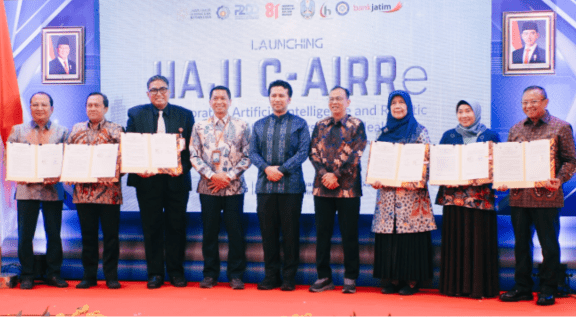
Digital transformation in the healthcare sector continues to develop in line with the growing need for services that are fast, easy, and efficient. To address this challenge, Institut Teknologi Sepuluh Nopember (ITS), together with RSUD Haji Regional Hospital of East Java Province and Universitas Airlangga (Unair), introduces Robot Assistant RAISA as part of the HAJI C-AIRRe collaboration (Collaborative Artificial Intelligence and Robotic Ecosystem in Healthcare). This robot is designed to support hospital services through the use of artificial intelligence (AI) technology.
Robot RAISA is the latest generation of a robot innovation previously developed by ITS and Unair to assist healthcare workers during the Covid-19 pandemic. While RAISA previously served as a support robot for patient care in isolation wards, its capabilities have now evolved into those of a service robot capable of interacting directly with patients and hospital visitors.
One of the main advantages of Robot RAISA is its ability to interact intelligently through AI Chatbot technology. This robot is able to understand user questions and provide natural responses similar to a conversation between humans. In the initial implementation stage, the information provided focuses on services at RSUD Haji Regional Hospital of East Java Province, such as information on outpatient clinics, service flow, hospital facilities, and various services available to patients and visitors.
The development of Robot RAISA does not stop at information services. In the future, this system is planned to include a cashless hospital payment feature (cashless). Through this feature, patients will be able to make payments directly through Robot RAISA, while the validation process is still carried out by the RSUD Haji finance team. This integration is expected to provide a more practical service experience while supporting the digitalization of the hospital’s administrative processes.
In addition to serving as an information center, Robot RAISA also has independent navigation capabilities. Equipped with Simultaneous Localization and Mapping (SLAM) technology, the robot can recognize its surroundings, map the hospital area, and automatically guide patients or visitors to their intended rooms. This capability is expected to make it easier for visitors unfamiliar with the hospital layout, while also reducing the burden on information staff.
In its implementation, Robot RAISA is also integrated with an AI-based chatbot to answer various user questions. Meanwhile, RSUD Haji has also developed an internal chatbot called Minji through the hospital’s Information Technology Team. Functionally, the chatbot on Robot RAISA and Minji share the same purpose, namely providing fast and accurate information services to users. The difference lies in their developers, where Robot RAISA’s chatbot was developed through collaboration with ITS, while Minji is an innovation built independently by RSUD Haji’s IT Team.
The collaboration between ITS, RSUD Haji Regional Hospital of East Java Province, and Universitas Airlangga serves as an example of synergy between universities and hospitals in producing innovations that address real needs in the field. Through the development of Robot RAISA, the three institutions not only introduce artificial intelligence-based technology, but also build a healthcare service ecosystem that is more modern, efficient, and oriented toward the patient experience.
Looking ahead, Robot RAISA is expected to continue being developed with various new features that support hospital services comprehensively. With intelligent communication capabilities, automatic navigation, and the potential integration of digital administrative services, RAISA is expected to become one of the pioneers in the implementation of AI-based service robots in Indonesian hospitals, while also strengthening the digital transformation of the national healthcare sector.