
About

Published on
Sunday, 31 May 2026
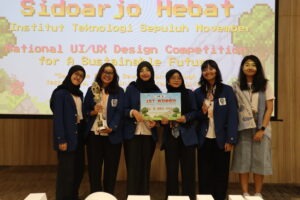
Image : Sidoarjo Hebat Team from ITS receiving the 1st Place award at the UI/UX National Competition Prog{r}amming 8.2.
Surabaya, F-ELECTICS – Unused clothing often ends up contributing to the growing problem of textile waste. Inspired by this issue, five students from Institut Teknologi Sepuluh Nopember (ITS) developed Clovear, a digital innovation based on the concept of circular fashion. Their idea successfully earned them 1st Place in the UI/UX National Competition at Prog{r}amming 8.2, organized by Prasetiya Mulya University.
The achievement was earned by the Sidoarjo Hebat Team, consisting of Joycelyn Emmanuella Passandaran from Computer Engineering, Diva Nesia Putri from Information Systems, Imelda Alexis Jovita and Siti Zahra Ananda Kurniawan from Informatics Engineering, and Dita Aulya Septiani from Visual Communication Design. Their diverse expertise in technology, design, and user analysis became the foundation for developing a solution that offers both innovation and meaningful social and environmental impact.
Interestingly, the team members have known each other since their school years. This long-standing friendship strengthened their collaboration throughout the competition. Sharing a common interest in UI/UX design, they decided to work together and take on the challenge presented by this national-level competition.
This year’s UI/UX National Competition Prog{r}amming 8.2 adopted the theme “Save the Earth: Revolution through Technology, Maintaining Sustainability.” Participants were challenged to design digital solutions capable of addressing sustainability issues and creating positive environmental impact. Among the available subthemes, the Sidoarjo Hebat Team chose Sustainable Digital Marketplace and incorporated aspects of Community and Social Impact through an innovation focused on sustainable fashion.
Their idea took shape as Clovear, a mobile application that enables users to exchange pre-loved clothing with others. The app also features a swipe-and-match system that helps users discover new fashion styles without purchasing new clothes. Through its circular fashion approach, Clovear aims to reduce textile waste while encouraging the reuse of wearable clothing.
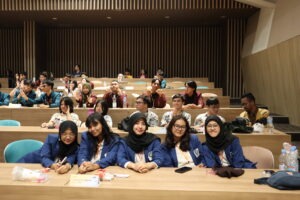
Image: Sidoarjo Hebat Team from ITS during the UI/UX National Competition Prog{r}amming 8.2.
The inspiration behind Clovear came from a common everyday problem. Many people have closets filled with clothes they rarely wear, yet they continue purchasing new items to keep up with changing fashion trends. This behavior contributes significantly to the increasing amount of waste generated by the fashion industry.
To ensure that the solution truly addressed user needs, the team adopted a Design Thinking approach throughout the development process. Through interviews, literature reviews, and prototype testing, they sought to better understand user needs while designing an effective and user-friendly solution.
“Our workflow followed the five stages of Stanford’s Design Thinking process, from empathize to testing,” explained Zahra.
During the development process, the team faced several challenges. One of the most significant was the limited availability of references for clothing exchange platforms that operate without buying and selling transactions. This encouraged the team to explore the concept further and develop a unique approach that could offer genuine value.
Clovear’s success was largely driven by the team’s willingness to address an issue that is still rarely discussed in digital innovation competitions. While many environmental solutions focus on more mainstream topics, Clovear specifically highlights the environmental impact of fast fashion, an issue that often receives limited attention in Indonesia.
According to Joycelyn, one of Clovear’s greatest strengths lies in its ability to present an environmental innovation that stands out from existing solutions.
“The main strength of our solution is an environmental innovation that is not focused on mainstream themes,” she explained.
Currently, Clovear remains at the concept and prototype stage, developed primarily for the competition. However, the team is open to further development and implementation opportunities in the future. With its potential, Clovear could become a meaningful digital solution for reducing textile waste and promoting more sustainable fashion practices.
Through this achievement, the Sidoarjo Hebat Team hopes to inspire more students to develop innovations based on everyday challenges around them.
“Innovation does not always have to address major problems. Observe our surroundings and innovate to solve environmental issues in everyday life,” concluded Joycelyn.