About
Published on
Friday, 4 September 2026
Carrying an artificial intelligence-based solution to address a real-world industry case study, a cross-departmental team of ITS students won 1st Place at CYBERHACK 2026.
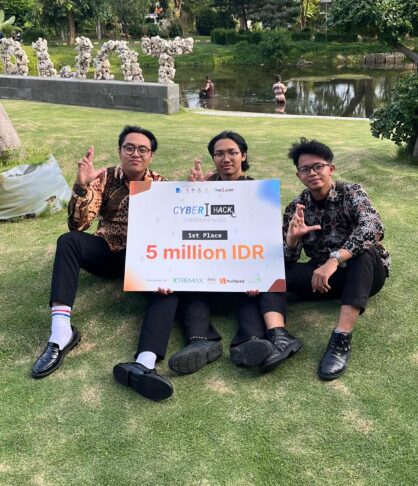
Surabaya, FTEIC ITS – Praditya Haekal Islami Al Haqiqi, a student from the ITS Electrical Engineering Department class of 2024, together with his two teammates, Rayhan Agnan Kusuma and Rayka Dharma Pranandita, both students from the Information Technology Department class of 2024, won 1st Place at CYBERHACK 2026 under the team name “SEMOGA YANG DISEMOGAKAN TERSEMOGAKAN”.
CYBERHACK 2026 is a hackathon-type competition that presents a real case study from a company collaborating with an institution to find a solution to a specific problem. Participants are challenged to formulate solutions that are both practical and realistic, covering aspects such as tools, usability, business, market, and implementation feasibility based on a realistic timeline. All proposed solutions are artificial intelligence (AI)-based and developed individually by each participant within the team.
Interestingly, the team name “SEMOGA YANG DISEMOGAKAN TERSEMOGAKAN” (roughly, “SEMOGA YANG DISEMOGAKAN TERSEMOGAKAN”) has its own story behind it. Haekal and Rayhan, who were previously alumni of the same vocational high school, had known each other for a long time before Rayhan introduced Rayka to Haekal. The team, formed since their first semester, had taken part in quite a few competitions before, but repeatedly experienced defeat. From a moment of sharing their feelings of demotivation over consecutive losses, the team name emerged as a representation of hope for the three of them, which they then carried into CYBERHACK 2026. Their reason for joining this particular competition was simple: the field being competed in felt well-suited to the team’s combined skill set.
In carrying out the project, the team divided roles clearly according to each member’s capacity. Haekal served as project manager, responsible for keeping the focus on the minimum viable product (MVP) and maintaining overall control over the development scope, while also handling a small part of the business side. Rayka focused entirely on the technical side of solution development, while Rayhan handled UI/UX along with the overall user interface and user experience aspects. For pitching practice, Haekal gave his teammates the freedom to rehearse according to their own capacity and comfort, without pressure.
The biggest challenge the team faced was limited working time. The case study was only given out on May 23, while submission in presentation format (PPT) — to be followed by a pitching session — was scheduled for May 27 and later extended to May 28. With numerous assessment parameters ranging from AI, pitching, and business to market aspects, and given that the entire team came from an engineering background, the main technical challenge lay in building the AI system itself along with troubleshooting it under deadline pressure. To manage this, Haekal worked to keep the team’s atmosphere calm by holding to the principle of “alon-alon asal kelakon” (roughly, “slow and steady wins the race”).
According to Haekal, the key to the team’s success was consistency. The feelings of demotivation they had once experienced instead became a booster, driving the team to perform at their best in the final round, with a clear goal of winning and confidence in one of the key points of their presentation material. During the pitching session, every member gave it their all according to their respective roles and responsibilities.
In terms of strategy, the team deliberately designed their presentation to avoid the monotony of typical presentations, so that the judges and audience would not get bored. This strategy began with a hook at the start of the presentation, followed by a light-hearted opening, before moving into the core material, which was still delivered according to their capacity and supported by a well-developed technical and business framework.
The result came as a pleasant surprise for Haekal, who admitted he was used to being on the losing side in various previous competitions. He expressed deep appreciation for his two teammates, who saw the process through successfully, ultimately achieving their first-ever win and becoming 1st Place champions — an unforgettable first experience.
Looking ahead, Haekal hopes that he and his team can continue on a path that allows them to keep growing comfortably, whether in the field of cybersecurity or elsewhere. His hope is that he and his team will never give up, no matter what they face — be it failure, chaos, exhaustion, or feelings of demotivation.