About

Published on
Thursday, 19 November 2026
SURABAYA – FTEIC ITS, Hurian Yahya Tebe, a student at the Faculty of Intelligent Electrical and Informatics Technology (FTEIC), Institut Teknologi Sepuluh Nopember (ITS), is advancing the idea of critical, ethical, and genuinely useful artificial intelligence (AI) for students through the Google Student Ambassador 2026 Batch 2 program.
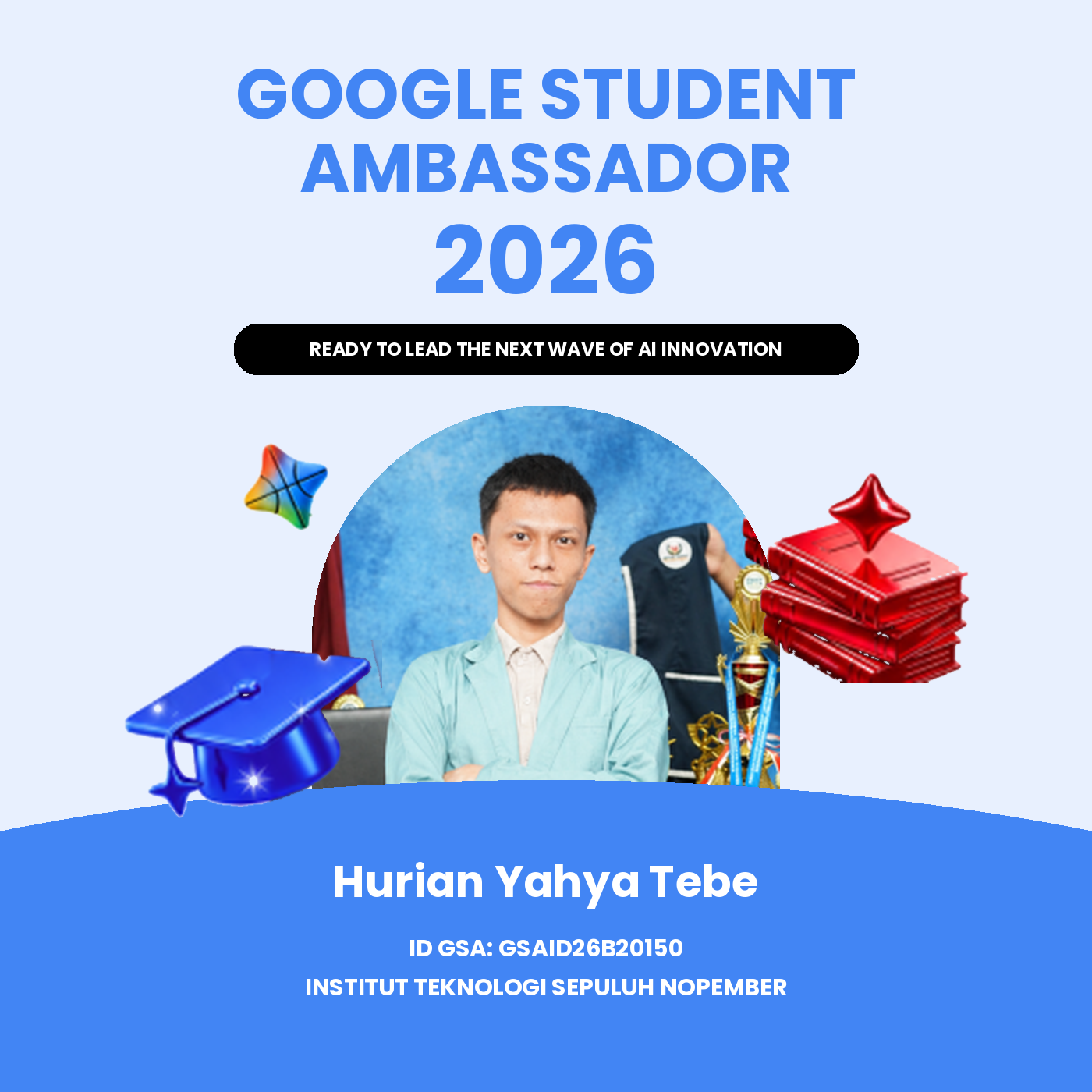
Hurian’s motivation stems from a gap in technology use that he has observed among students. In his view, many students already use AI, but only by giving one-sentence instructions that produce shallow results. Having experienced the demanding technical learning pace at FTEIC, he realized that technology should accelerate critical thinking and problem solving, not serve as an instant shortcut.
Hurian acknowledges that this nationwide program brings prestige and adds value to his portfolio. However, his biggest drive is technical curiosity and a desire to build community. He measures success by how many fellow students he helps handle their academic workload and prepare for their careers through concrete training, not by the ceremonial status of being an ambassador.
In carrying out his role, Hurian brings the values of inclusive leadership, academic integrity, and Responsible AI. He wants to instill the understanding that AI is a co-editor and research assistant, not a tool for fabricating data. He believes delivering real benefit is different from merely promoting a product. Promotion stops at adoption or download numbers, while real benefit focuses on solving the audience’s problems. For this reason, when introducing Gemini Study Notebooks and Gemini Canvas, he emphasizes practical solutions, such as turning dense lecture material into active-recall quizzes and crafting a credible CV.
To make this happen, Hurian has designed two offline workshops on the ITS campus. The first, Gemini Study Notebooks and Master Prompting, targets active students in informatics and intelligent technology fields. Participants learn to turn course documents and technical slides into structured summaries and interactive practice quizzes. The second, Gemini Canvas and Google Search AI Mode, is aimed at new students, helping them research the qualifications for committee divisions and refine their CV structure using the STAR and SMART methods.
Both events are planned to take place at the Aula Asrama and the IKOMA ITS Creative Co-Working Space. Hurian believes an informal approach that lowers logistical barriers is effective in drawing student participation. His success indicators include active participant attendance at every session, 100% of participants able to practice the workflow through to producing an independent draft, and participants publishing their work on social media. To sustain enthusiasm, he pairs technical knowledge transfer with an academic incentive: access to licensed Dicoding classes.
Hurian has also anticipated several obstacles, including clashes between academic schedules and faculty student activities, fatigue with online sessions, and low weekend participation. His strategy is to design practice-heavy 60-minute sessions without lengthy theory, choose locations near where students live, and open structured registration through a QR-coded Google Form, with meals and programming course certification as benefits.
So that the material is not enjoyed only by computer science students, it is designed with non-technical analogies. Prompt engineering is broken into a simple framework: role setting, problem context, task instruction, and output format constraints. Example cases span disciplines, such as reading journal articles, drafting a weekly study plan, and writing a motivation letter for a campus organization.
At the same time, Hurian remains critical of the technology he promotes. In every session, he explains the risk of hallucination in large language models, so verification against primary sources remains mandatory. He also reminds participants not to enter sensitive data or personal information into public platforms, and to be aware of algorithmic bias. For him, Google’s technology is a tool for thinking that must always be balanced by human reasoning and validation.
Looking ahead, Hurian hopes to leave behind a culture of smart, evidence-based learning on campus, where students see AI as an ethical partner in reasoning. For him, the program is also a way to hone leadership, public communication, and community-based program management. He advises fellow students who want to contribute not to chase the ambassador role merely for title validation on social media. “Focus on the real problems of the peers around you, then use the technological capacity you have to offer solutions that are measurable, honest, and useful,” he said.(Humas-Sh)