About
Published on
Friday, 9 October 2026
Students of FTEIC ITS once again strengthen international collaboration. This time through a student exchange program to one of the leading universities in Malaysia. This experience is part of the effort to broaden the academic and cultural horizons of FTEIC students at the international level.
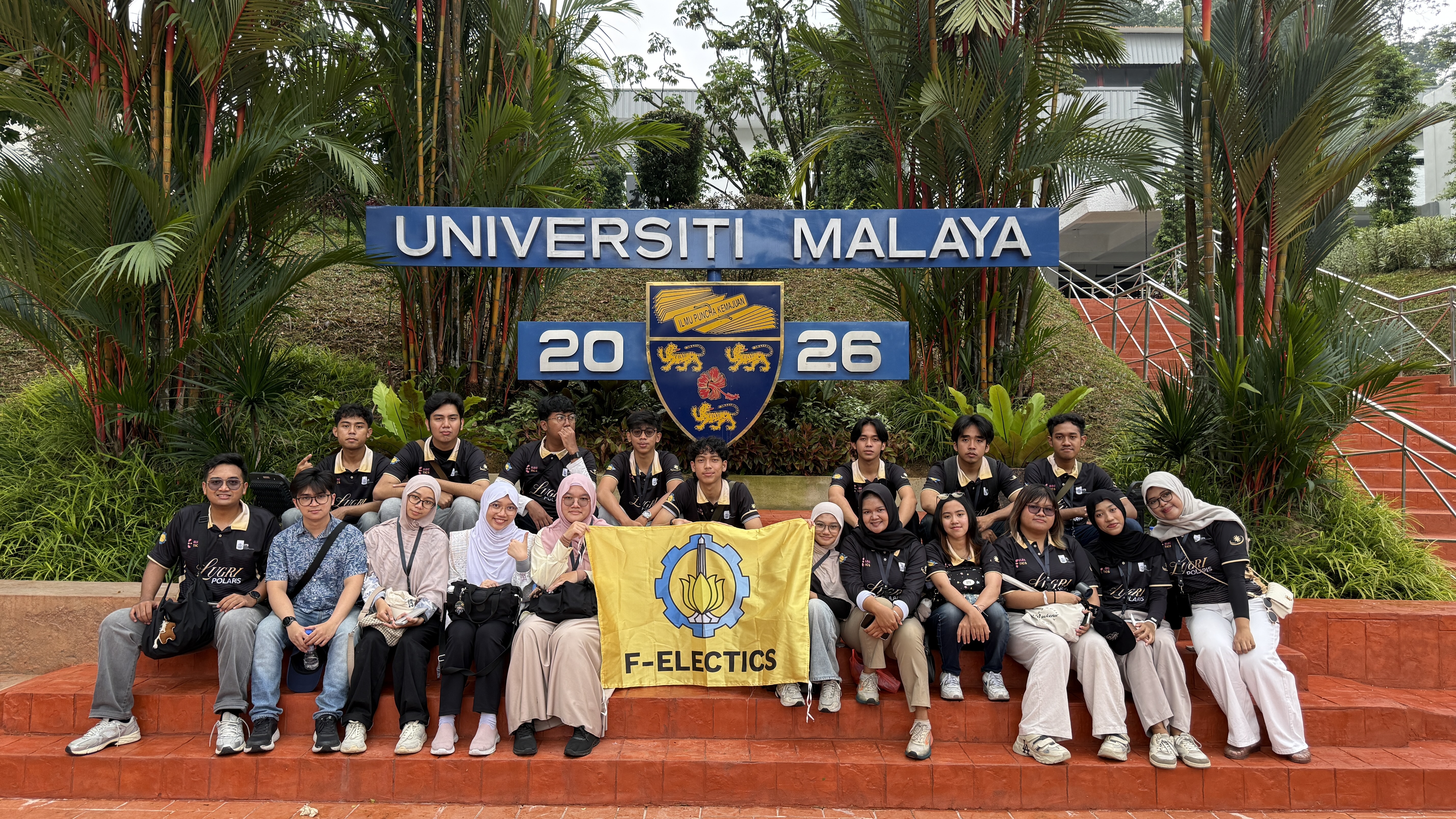
Surabaya, FTEIC ITS – A delegation from the Faculty of Electrical Technology and Intelligent Informatics (FTEIC) ITS had the opportunity to take part in an exchange program to Universiti Malaya (UM), as part of the Internatics program series. This program involved students from various departments at FTEIC, namely Electrical Engineering, Biomedical Engineering, Computer Engineering, and Informatics Engineering.
One of the delegation members, Muhammad Rizqi Fadhlurrahman, a Telecommunication Engineering student from the 2023 batch, explained that the visit to Universiti Malaya was a reciprocal part of the Internatics program. The first stage took place in Surabaya, when 20 students from Universiti Malaya visited ITS from August 2–12, 2026. The second stage was the FTEIC delegation’s visit to Malaysia. This program involved FTEIC ITS as a whole as the organizer, Universiti Malaya as the host, and also involved Universitas Mataram (UNRAM). While in Malaysia, the FTEIC delegation also met and took part in activities together with students from Universitas Mataram.
According to Rizqi, his interest in joining this program stemmed from a desire to represent FTEIC ITS at the international level. After Universiti Malaya students visited ITS as part of Internatics, the visit to Universiti Malaya felt like a natural continuation of the collaboration between the two institutions. He wanted to learn directly from the academic environment and culture there, while also helping to strengthen the relationship between the institutions. The selection process began with filling out a registration link that was shared, after which participants were contacted further by the relevant department.
Throughout the program, the FTEIC delegation took part in a variety of activities, ranging from academic to cultural ones. On the academic side, they took part in a faculty tour, which gave them an overview of the learning environment at Universiti Malaya, as well as an interactive session with Dr. Dewi Kasturi on Artificial Intelligence (AI) and data management related to data science. The session was delivered interactively using Quizizz, in a race-like format, making the fairly technical concepts easier to understand and more engaging.
One of the most memorable insights for Rizqi from the session was how several AI tools can be combined to process data, with the results then visualized and presented using Tableau software. This insight showed that AI does not have to be used separately, but can instead be combined into a more efficient data-processing workflow.
On the cultural side, the delegation was taken to visit the Malaysia Tourism Centre (MaTiC), a venue for cultural dance performances showcasing traditional Malaysian dances. They also toured Kuala Lumpur City Centre (KLCC), visited Pasar Seni (Central Market), and stopped by Beryl’s Chocolate. Universiti Malaya warmly welcomed the FTEIC delegation, accompanied by buddies who assisted throughout the entire series of activities, from the faculty tour to cultural visits. The program concluded with a farewell party, where the FTEIC delegation danced together with UNRAM students and their UM buddies on stage, marking a memorable closing moment for the whole delegation.
Throughout the program, the FTEIC delegation also built relationships with students from Universiti Malaya and Universitas Mataram. The process of building relationships with UM felt natural thanks to the support of the buddies from the faculty tour through to the cultural visits. Meanwhile, closeness with UNRAM grew because ITS and UNRAM students were grouped together to work on joint assignments, including a video-making competition.
In terms of adaptation, Rizqi admitted that he did not face any significant challenges during the program, especially in terms of culture, thanks to the warmth of Universiti Malaya, the support of the buddies, and the cultural closeness between the two countries. Even so, the program still provided valuable lessons, particularly on how to collaborate and communicate with people from different university backgrounds.
Through this exchange program, Rizqi hopes that the experience gained can serve as a foundation for continued growth, both in academic ability and in cross-cultural communication and networking. He also hopes that the collaboration between FTEIC ITS and Universiti Malaya will continue to strengthen, and that more FTEIC ITS students will have the opportunity to take part in similar programs in the future. (Humas-Sh)