About

Equipped with robotics experience dating back to elementary school, a Telecommunication Engineering student from Institut Teknologi Sepuluh Nopember (ITS) has achieved a proud result by winning 2nd Place in the Robot Transporter Competition category at the Technocorner 2026 event, organized by Universitas Gadjah Mada.
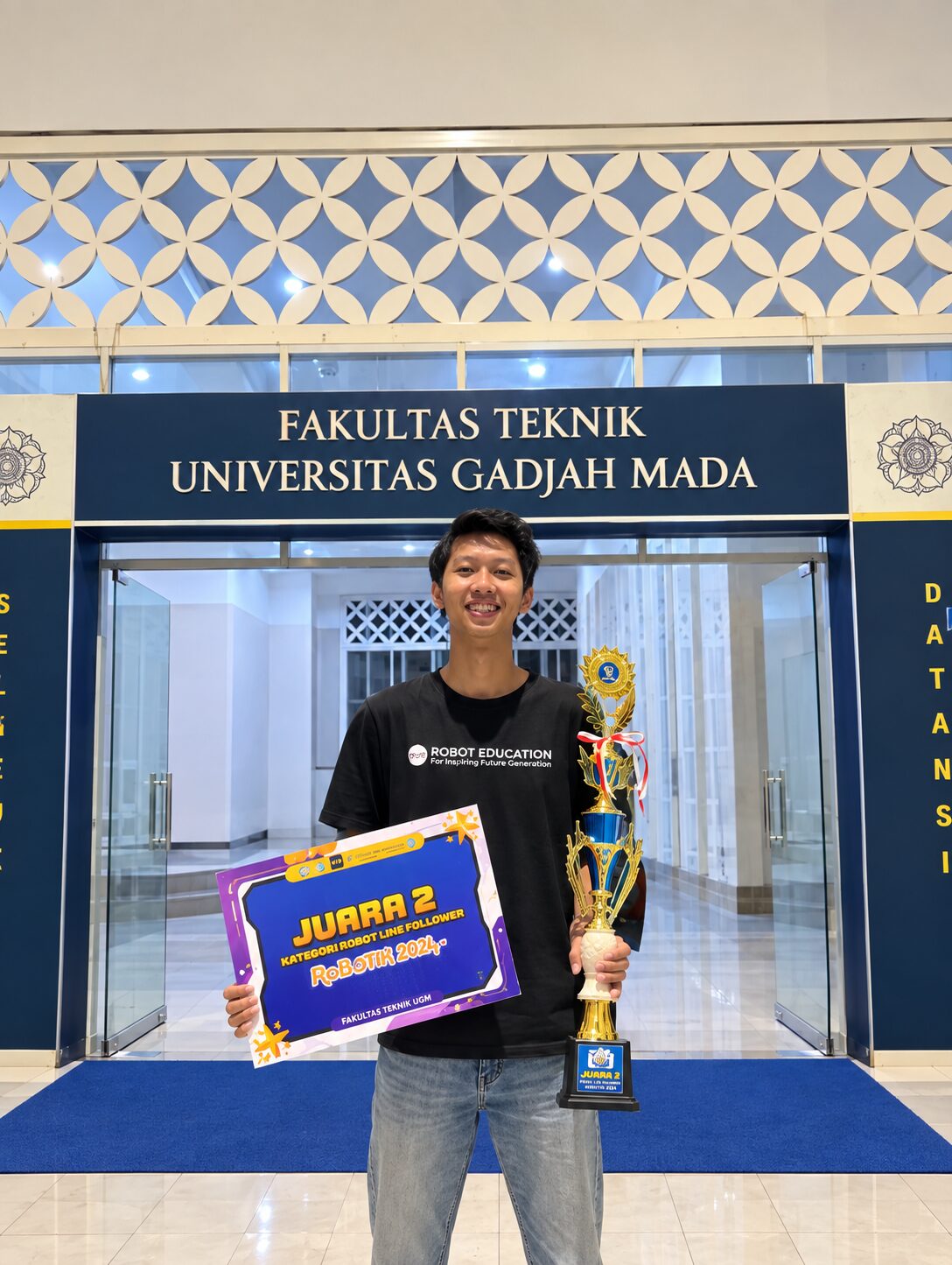
Surabaya, FTEIC ITS – Keefe Wiryawan Salim, a student from the Department of Electrical Engineering, Telecommunication Engineering study program at Institut Teknologi Sepuluh Nopember (ITS), originally from Surabaya, class of 2025, has won 2nd Place in the Robot Transporter Competition category at Technocorner 2026. Keefe competed individually in this event, without being accompanied by any team members.
Technocorner 2026 is a national-level competition held annually by the Faculty of Electrical Engineering and Information Technology of Universitas Gadjah Mada (UGM). The competition took place from June 25–27, 2026, at the UGM Faculty of Engineering building. In the Robot Transporter Competition category, several general rules applied, including that robots may only be operated using a remote controller, such as a PlayStation stick or a mobile phone, and that each team is only allowed to use one robot throughout the competition.
Keefe’s interest in joining the Technocorner 2026 Robot Transporter Competition was driven by his desire to obtain a championship certificate to fulfill his Student Extracurricular Credit System (SKEM) requirements. In addition, his passion for robotics has grown since elementary school through robotics extracurricular activities. Since 2020, Technocorner has become a competition he regularly enters every year. His competitive journey has also been shaped by the robotics club he belongs to, RobotEducation, which has played a role in his continued participation in various robotics competitions.
In his preparation process, Keefe explained that he mostly focused on practicing and evaluating the parts of the robot that needed improvement so that it could perform well in the competition arena. Meanwhile, the design, assembly, and programming of the robot were entirely handled by his coach and his robotics club, RobotEducation, while Keefe himself took on the role of driver, operating the robot during the matches. The total preparation time took about one month, covering the design, programming, and assembly stages, with the final two weeks before the competition dedicated to hands-on practice in the arena to sharpen both the robot’s readiness and his skills as a driver in operating the transporter robot.
The biggest challenge Keefe faced during his preparation was that his competition training schedule clashed with the End-of-Semester Evaluation (EAS) period at his campus. This situation made it quite difficult for him to manage his time, particularly in prioritizing between preparing for his EAS exams and training for the competition as the event drew closer. Even so, he continued to try to balance both responsibilities in order to maintain his performance both academically and in the competition arena.
According to Keefe, the running of Technocorner 2026 was, in his view, the least consistent edition of the competition he had ever taken part in, whether in terms of the judges’ or referees’ decisions, the condition of the competition track, or the mission cubes used during the matches. The most memorable moment for him was successfully advancing to the final round, which he saw as proof of the results of the training and preparation he had gone through. Meanwhile, the most tense moment occurred during the final itself, where he admitted to being inconsistent in placing the cubes for the given mission, ultimately losing to the opposing team based on mission completion time.
The strength of Keefe’s robot lies in its design, which was tailored to match the competition’s concept, allowing it to be controlled effectively throughout the match. Beyond the robot’s design itself, Keefe also emphasized the importance of the driver’s role, who must be able to control the transporter robot both consistently and quickly, as speed and precision were among the key factors determining the final outcome of the match, especially during crucial rounds such as the final.
Keefe expressed that he felt happy and proud of his achievement in winning 2nd Place, even though he was not able to secure 1st Place in the competition. He also expressed his gratitude as a form of appreciation for the long process he went through, from regular training to the effort of balancing his time between academics and competition preparation. Looking ahead, regarding his hopes for robotics competitions in general, Keefe hopes that the consistency of the organizing committee, along with all the technical requirements of the competition — including the track, mission cubes, and judges’ decisions — will be given greater attention so that future competitions can run more smoothly and fairly for all participants.