About
Published on
Friday, 4 September 2026
Highlighting the major theme of smart and sustainable electrical system transformation, three Electrical Engineering students from ITS won 1st Place in the Senior Innovation Challenge, part of the National Electrical Power System Competition (NESCO) Innovation Challenge 2026 series, with their innovation titled RE-TRANSFORM.
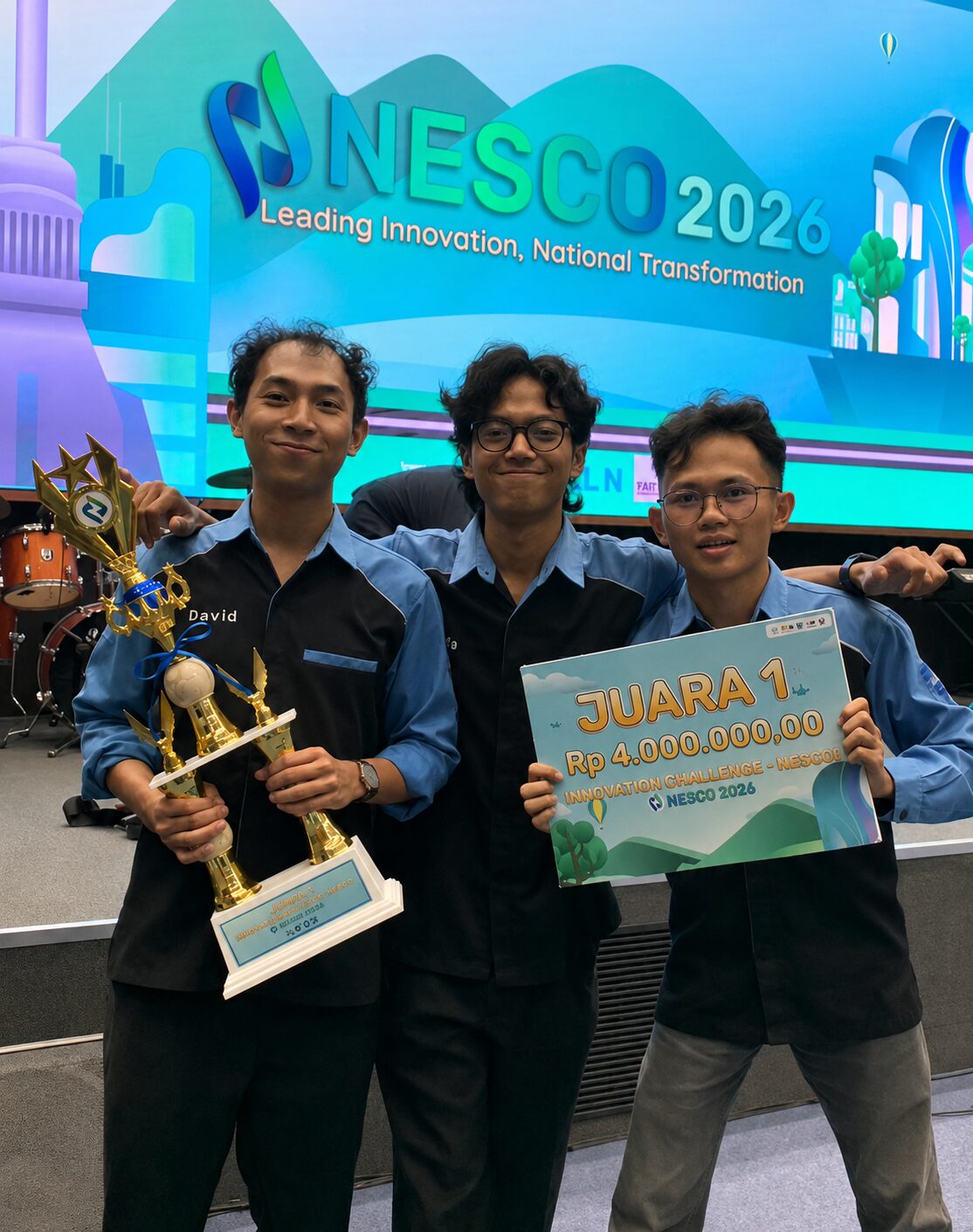
Surabaya, FT-EIC ITS – Katon Suryo Andaru, an Electrical Engineering student from the ITS class of 2024, together with his two teammates, Moch Yusuf Pambudi and Raihan Imaduddin Ahmad, also Electrical Engineering students from the class of 2024, won 1st Place in the Senior Innovation Challenge, part of the National Electrical Power System Competition (NESCO) Innovation Challenge 2026 series held on May 9, 2026.
NESCO Innovation Challenge 2026 is a national-level scientific and innovation competition focused on problem solving in the electricity and energy systems sector, organized by Magatrika under the supervision of KMTETI FT UGM. The main theme carried this year was “Transforming Green Power Systems for a Smart, Resilient, and Sustainable Electrified Future”, seeking transformative ideas to realize a smart, resilient, and sustainable electrical system. In this competition, Katon’s team chose the sub-theme “Future-Ready Power Infrastructure”, which focuses on adaptive infrastructure modernization to accommodate the rapid growth of electric vehicles (EVs).
The idea behind RE-TRANSFORM stems from the government’s projection to operate 2 million electric cars by 2030 in order to achieve the Net Zero Emission 2060 target. However, this massive EV adoption gives rise to the phenomenon of simultaneous nighttime charging, which threatens the reliability of residential distribution transformers. This sharp load surge risks triggering overheating, systematic damage, and even blackouts. On the other hand, the EV transition also creates a lithium-ion battery waste problem, where batteries whose capacity has dropped to the 70–80 percent range are actually still very viable for use as static energy storage.
The idea-finding process began with studying reference works from senior students who had taken part in similar competitions in previous years. While dissecting these various references, the team’s attention turned to the topic of electric vehicles. Through further literature research and discussion, they discovered the potential threat of overload on distribution transformers caused by simultaneous EV charging. From there, a solution began to take shape, eventually becoming the seed of the RE-TRANSFORM idea. Once the core idea was formed, the team refined it through deeper literature research and conducted various simulations using MATLAB software to validate the concept and assess the potential effectiveness of the proposed solution.
In carrying out the project, Katon Suryo Andaru acted as team leader, responsible for coordinating the members, formulating the core idea and system integration, and structuring and writing the overall essay. Moch Yusuf Pambudi focused on designing the Second-Life Battery Energy Storage System (SL-BESS) infrastructure, including how the system works and integrates with the Smart Controller. Raihan Imaduddin Ahmad focused on economic feasibility analysis, including Capital Expenditure (CAPEX) calculations and preparing tables and financial analysis as a basis for assessing the potential implementation of RE-TRANSFORM.
The biggest challenge the team faced was time management due to each member’s busy schedule. Their packed routines of laboratory practicums and organizational activities left very limited free time to gather and hold intensive discussions. The situation grew even more difficult when two team members fell ill, reducing the team’s effective preparation hours. To overcome this challenge, the team applied the principle of consistently chipping away at the work bit by bit. This limited time made the process of finishing and submitting their work come down to the wire against the final deadline, yet the team kept striving to make the most of every remaining moment to perfect their idea, ultimately succeeding in winning the championship title.
The competition journey began with a brainstorming process, followed by the formulation and development of the innovation, writing the paper, and finally the submission stage. The most challenging part came at the final stage, especially during the Q&A session with the panel of judges, where the team was required to truly understand every aspect of the innovation they proposed and be able to answer clearly and convincingly.
The innovation proposed by the team offers a solution to the reliance on grid reinforcement — namely, replacing large-capacity transformers and cable networks, which is very costly and cuts off the power supply during installation. RE-TRANSFORM has four main advantages: a plug-and-play system that can delay grid reinforcement by 4–6 years, saving utilities billions of rupiah in capital expenditure (CAPEX) per substation; the use of used EV batteries, making storage components far cheaper; addressing the threat of hazardous battery waste by significantly reducing the life-cycle carbon footprint; and acting as a reliable buffer in stabilizing current fluctuations caused by weather intermittency from rooftop solar power systems (PLTS).
According to Katon, the team’s success hinged on several aspects. In terms of innovation, an idea must have clear urgency, deliver strong impact, and offer a provable element of novelty, backed by a solid gap analysis against existing solutions or products so that it is clear why the innovation is genuinely needed. In terms of writing, the work must have good structure and grammar and be easy to understand, even for readers without a technical background, while making strong and logical use of data, calculation analyses such as CAPEX and OPEX, feature completeness, and implementation projections. In terms of presentation, the most important thing is to convey the idea briefly, concisely, and clearly, with a strong hook at the start to keep the judges engaged and following the idea through to the end. However, he said, the most important part is the Q&A session, since it is the opportunity to explain the innovation in greater depth to the judges — meaning it is not enough to simply memorize the presentation material, but the team must truly understand the innovation they created.
Katon and his team say they are very grateful and happy with the result they achieved. From the start, they did not have particularly high expectations of even reaching the final round, let alone winning. That is why, when they were finally announced as 1st Place winners, it became a deeply memorable experience for the team, especially given how smoothly the entire competition process went — from preparing their work to the presentation and Q&A session in the final round. For the team, this achievement also proves that even amid various time constraints and busy schedules, as long as a team keeps working and giving its best effort, unexpected results can still be achieved.